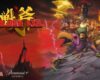
English Dub Season Review: Jaadugar: A Witch in Mongolia Season One
Overview (Spoilers Below):
After losing her mother and her homeland, Sitara’s (Cristina Vee) despair transforms into determination with the power of knowledge. New possibilities unfold when a family of scholars takes her in, deepening her education. Meanwhile, Genghis Khan’s Mongol Empire conquers nation after nation, nearing Sitara’s new home. After the Fourth Prince of the empire takes her captive, a flame of revenge is ignited.
Our Take:
Jaadugar: A Witch in Mongolia is an anime adaptation of a manga series, A Witch’s Life in Mongol, written and illustrated by Tomato Soup. It is directed by Abel Góngora, known for directing promotional episodes of “OK K.O.! Let’s Be Heroes” and T0-B1 from “Star Wars: Visions”. Naoko Yamada serves as the series’s chief director, with Kanichi Katou handling the script. It is produced by Science Saru, known for working on other projects such as Yurei Deco, Dandadan, Sanda, Ride Your Wave, and The Colors Within. Kenichi Yoshida designs the characters and serves as chief animator, while Kōshirō Hino composes the music. The opening theme song, “Stella”, is performed by Sekai no Owari, and Queen Bee performs the ending theme song, “Hoshi” (‘Star’).
They say that knowledge has the power to change the world for the better. But in an era where life is in ruins because of the invaders, knowledge can also spark the courage to fight back and reclaim the hope that was stolen. Usually, we see protagonists embark on a revenge quest to confront and dispose of enemies who’ve wronged them, often through violence. However, for this particular hero, the only way to achieve vengeance is through smarts instead of fists. This highlights an inspirational journey of an enslaved girl whose new life was taken away from her by the invading Mongolians, prompting her to survive through her smarts and retrieve what was stolen from her.
That journey is the concept behind Tomato Soup’s manga series, A Witch’s Life in Mongol, which is based on Mongol history set in the early 13th century. Its anime adaptation, titled Jaadugar: A Witch in Mongolia, follows this historical path through the eyes of its protagonist, an orphan named Sitara. The twelve-episode first season chronicles Sitara’s life-changing journey, which begins when she is sold to a rich but kind scholar family. As she learns the importance of knowledge, the Mongols invade her new home in Tus, slay her master Fatima (Marwa Elda), and steal the book of Elements. Now a captive, Sitara takes on her former master’s name and begins her plot to take down the Mongol Empire from within.
I’m not much of a history geek, but I took some classes in school to better understand the world around me, both past and present. However, there was one piece of history I haven’t learned as much about as others: the Mongols and their conquest. Knowing the anime is based on that side of history, I was interested to see how it is represented in its accuracy and storytelling. Of course, my interest piqued even more when I found out it is another adaptation produced by Science Saru, whose ambitious stylization and artistic creativity made it a household name in the animation department. Dandadan may be hard to outmatch because its animation is undoubtedly spectacular, but I admire the effort to make the presentation feel more alive than in other anime adaptations.
For Jaadugar, Science Saru tried something different with its presentation, especially in its art and character designs. The illustrations in A Witch’s Life in Mongol have a distinct personality, portraying the characters as cartoon-like individuals with oval-shaped heads and bringing Iranian culture and artistic traditions to life like paintings. Science Saru aims to replicate this manga style, and the result is another glorious feast for the eyes. Though it may look simple by design rather than detailed, Science Saru knows how to make the simplest of art appear stunning. One example is the vision of Tolui rescuing Ogedei in the tenth episode, “Wisdom,” where the animation showcases the former’s sacrifice metaphorically. I still prefer the studio’s work in Dandadan for its ambition and depth, but the presentation in Jaadugar further highlights Science Saru’s art and creative mind in any illustration, especially those from a source material like this.
As for the story itself, I was honestly surprised at how engaged I was in its journey. Jaadugar shares a similar vibe with other projects based on historical events. However, what makes the anime engaging is how it conveys the emotion behind Sitara’s journey and its themes. When we’re first introduced to Sitara, she is reluctant to learn from her scholar family. However, after meeting Fatima’s son, Muhammad (Yussef Benelbar), she begins to understand how knowledge can help her adapt to the world around her, especially as she explores new horizons as a Mongolian captive. This leads her to use that knowledge to sneakily exact revenge on the Mongols instead of resorting to violence. Along with its themes of hope amid despair, Jaadugar depicts knowledge as a key tool for learning about the world, its resources, and even survival, with a notable example being the rahj al-gar poisoning. While it briefly falters in its pacing at times, Jaadugar offers an engrossing, subtly emotional reflection on the power of knowledge and the Mongols’ harshness.
I would also credit the English dub for casting actors who can portray the show’s characters and Iranian accents. From what I’ve seen, there are a few actors from that particular culture to convey the characters authentically, further enriching the history it represents, including Marwa Elda for Fatima and Yussef Benelbar for Muhammad. If that’s the case, I admire the effort to stay true to the culture from a voice direction perspective. Cristina Vee did a solid job conveying Sitara’s emotional range through her performance, whether the character is internally conflicted or manipulative in gaining the Mongols’ trust. Sitara grows to learn how knowledge can become her trusted ally amid desperation and hopelessness, and Vee carries enough weight in her voice to make her an unexpected hero of this era.
Overall, Jaadugar: A Witch in Mongolia has enough knowledge to deliver another engaging and beautifully animated adaptation from Science Saru. Through its reflection on Iranian history and distinct presentation, the series provided a surprisingly good depiction of how knowledge plays a crucial role in Sitara’s vengeance and the Mongols’ conquest. Despite its mild pacing issues, this is another anime I was hesitant about at first, but I was completely shocked by the effort in its craft and premise. It’s not as innovative or exciting as other Science Saru projects, like Dandadan, which I still consider my favorite from the studio. However, it further showcases Science Saru’s ability to convey the stylization and art depicted in source materials. What’s even better is that I learned plenty about Mongolian history from the series, so if you’re a history buff, you might enjoy its representation.