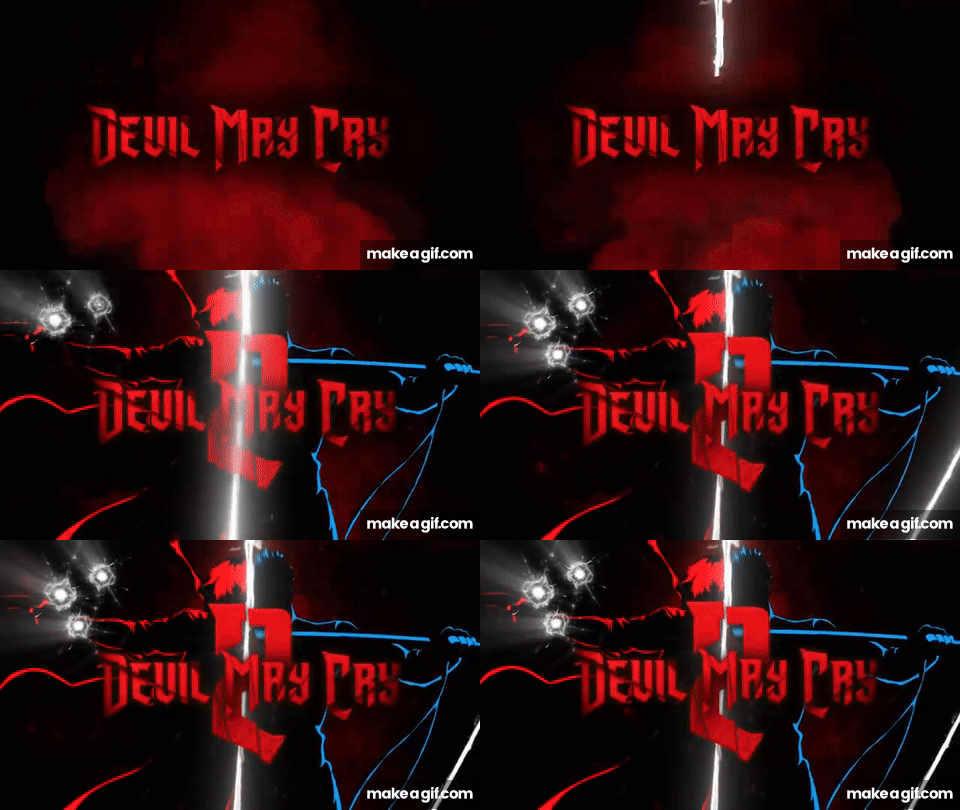
English Dub Season Review: Devil May Cry Season Two
Long after the events of Season One, the United States government finds itself locked in a brutal war against the Demon Realm of Makai, with Vice President Baines and European aristocrat Arius von Erenburg pulling strings behind the scenes as tensions between humanity and demonkind threaten to tear both worlds apart. At the center of the chaos stands Dante (Johnny Yong Bosch), the wisecracking demon hunter for hire and orphan bearing the bloodline of the legendary demon swordsman Sparda. But as the portal between realms begins to open and the conflict spirals into all-out war, Dante is forced to confront not only the darkness within himself, but also the one enemy who mirrors his power and heritage, his long-lost twin brother Vergil (Robbie Daymond), who makes a big return. But due to the brutal nature of how he was raised by the cruel & merciless Demon King Mundus (Ray Chase) away from humanity, this results in Vergil no longer being the sibling Dante once knew…
On the technical side, much of the cast of Season One has mostly been carried over to this adaptation created by Adi Shankar (Castlevania and the Blood Dragon spin-off Captain Laserhawk), who serves as executive producer, and Alex Larsen as a writer for the series. The animation was done by South Korean animation studio Studio Mir (The Legend of Korra, The Witcher: Nightmare of the Wolf, Lookism, X-Men 97, and Mortal Kombat Legends: Scorpion’s Revenge). The Band Power Glove is the show’s composers, mostly doing slow-paced, atmospheric covers of DMC game music, along with the end credits.
The best way to encapsulate the second season is with two words: escalation and chaos, while comedically asking the question: “What if the War on Terror had Devil Triggers and a nu-metal soundtrack?” It pushes its scale of violence and political commentary far beyond what the first season attempted, and for better or worse, doubles down on its parallels between the “War on Hell” and post-9/11 War on Terror propaganda, hammering home themes of militarization, corruption, and manufactured fear with absolutely zero subtlety. Following Dante’s cryogenic imprisonment at the end of Season 1, the opening episodes spend time exploring the fallout of humanity’s invasion into the Demon World of Makai (which most of human society blindly thinks is “Hell”), though the narrative does not fully pick up until Vergil suddenly arrives on Earth and makes his presence known. From the moment he steps into frame, Vergil becomes the star of the season; he’s the polar opposite of Dante: a strict, ruthless, and no-nonsense killer. He arrives on Earth in a shockingly brutal and unexpected way, leaving a lasting impression through a dynamic action sequence set to Drowning Pool’s “Bodies.” By Episode 2, Dante’s eventual release from cryo sleep, which evokes strong Demolition Man vibes, injects the series with much-needed levity along with fun visual gags and a renewed sense of momentum, swagger, and personality. Once both brothers finally take center stage, the season transforms into something far more compelling than it has any right to be.
format(webp))
At the heart of this season of 8 newly added episodes is the fractured bond between Dante and Vergil, which ultimately becomes its emotional spine. Vergil’s full introduction reframes the story into something far more tragic, centering on two brothers shaped by the same trauma but driven in opposite directions by it. Their rivalry is no longer just stylistic or ideological; it becomes personal, grief-stricken, and deeply rooted in childhood loss and unresolved pain. His cold, merciless personality contrasts perfectly against Dante’s carefree rockstar swagger and charm, while the expanded flashbacks involving their long-deceased mother, Eva (Kari Wahlgren), provide the emotional context that strengthens their rivalry. One of the more surprising improvements comes from Season 2 villain Arius, voiced by Graham McTavish, who gives the character an overzealous Scottish accent that strangely works in the show’s favor. Arius was originally introduced in Devil May Cry 2. A game that at one point was long considered the black sheep of the franchise before the infamous 2013 Ninja Theory reboot. As a villain within the games, Arius was previously remembered as a one-note aristocratic CEO dabbling in dark magic and demonic power. Here, however, the anime expands him into a more credible manipulator whose obsession with control and forbidden ancient power ties directly into the season’s larger themes of moral decay, unchecked authority, corporate greed and exploitation, right down to a darkly comedic, satirical propaganda commercial promoting his brand that feels like something pulled straight out of Paul Verhoeven’s works, such as RoboCop or Starship Troopers.
![Devil May Cry' Season 2 - Adi Shankar Promises an Unpredictable New Batch of Episodes [Images] - Bloody Disgusting](https://bloody-disgusting.com/wp-content/uploads/2026/02/Devil_May_Cry_n_S2_A.jpg)
For the rest of the voice cast, Johnny Yong Bosch and Robbie Daymond deliver genuinely strong performances, particularly during quieter moments where Dante and Vergil’s unresolved pain slips beneath their hardened exteriors. Vice President Baines, previously voiced by the late Kevin Conroy, is now portrayed by Ian James Corlett, who does a respectable job with the material he’s given as the sinister, authoritarian vice president. Newcomers such as Tara Strong also leave an impression as supporting character Nell Goldstein, a figure from the Devil May Cry light novels who played a significant role in Dante’s life by creating his signature Ebony & Ivory pistols. Despite her limited screentime, Strong plays the role with an entertaining Slappy Squirrel-like voice and likability. Keith David also appears in a memorable guest role as Lucan, an enigmatic “Professor” connected to Dante’s mercenary past with Enzo, whose unfortunate fate in Season 1 still lingers over several flashback scenes. And finally, Scout Taylor-Compton’s portrayal of Mary Arkham, better known as “Lady”, is arguably one of the season’s biggest improvements. Unlike Season 1, where much of her dialogue felt like her vocal cords were replaced with a mean-spirited Viziepop character, this season dramatically tones that aspect down and gives her far more emotional complexity. Instead of relying almost entirely on profanity, Lady is written with noticeably more restraint, allowing her growing moral conflict with Baines and the people she works for to land far more effectively. This progression gives her much-needed depth and pathos, while Taylor-Compton leans into the role with a more grounded and nuanced performance that makes her arc considerably more engaging.
Visually, the season remains a strong showcase for Studio Mir, delivering fluid, high-impact action sequences that are frequently dynamic and visually inventive. However, the show’s insistence on staging nearly every major set-piece like a full-blown nu-metal music video eventually becomes exhausting rather than exciting. Very little 3D cel-shading is used overall, and when it does appear, it is mostly reserved for Devil Trigger transformations or occasional kaiju-scale demon encounters, where it is applied sparingly rather than as a constant stylistic tool. While those moments can look striking, they stand out precisely because they are exceptions rather than the rule. The soundtrack itself is undeniably strong when taken on its own, packed with recognizable acts like Korn, Evanescence, and Papa Roach alongside creative remixes of tracks from the first season and certain pieces of music taken from the games, and also a New song by Papa Roach featuring. Hanumankind, along with a new Casey Edwards & Amira Elfeky song called “Bazooka”. But over time, the presentation starts to feel more performative than natural, as if the series is trying very hard to flaunt “edgelord coolness” rather than allowing the coolness itself to emerge organically. That constant aesthetic push-and-pull gives the season energy, but also makes it feel slightly self-conscious beneath all the chaos. Much like the previous season, the adaptation also leans heavily into game callbacks and franchise references while introducing new story elements unique to the anime. Some of those additions genuinely enhance the experience, as exemplified by certain boss battles from Devil May Cry 2 making unexpected appearances with actual narrative purpose. Others, however, reach a high point before immediately shooting itself in the foot with the forced political anti-war messaging that has nothing to do with the game franchise whatsoever. That unevenness extends to the narrative structure itself, particularly with flashbacks that appear at irregular and often disruptive points instead of being woven into the story more organically. Another persistent disappointment is the continued sidelining of the iconic and mystical “Devil Arm” weapons, which feels like a missed opportunity in a franchise so heavily tied to weapon-based style and variety.
Overall, Season 2 remains a slight improvement when you learn to look beyond the ugly & forced politics, as it becomes emotionally compelling once both brothers reunite. Most of the action scenes are a visual treat, and the heightened emotional stakes surrounding Dante, Vergil, and Lady give the series far more depth than before, while Arius’ expanded role helps make the central conflict feel more substantial. Although the writing can still be heavy-handed, predictable, and messy in its handling of established lore, the season succeeds through its character-driven drama, stylish action, and unapologetic embrace of chaos. It constantly oscillates between small improvements and the frustrating creative decisions you’d come to expect from anything made by Netflix, which keeps me from giving this a higher rating. Even so, its emotional sibling rivalry, stronger performances, game references, chaotic visual style, and aggressive soundtrack choices make parts of this feel much closer to the kind of wild, emotionally charged adaptation that fans hoped the series could eventually become. And with a third season already announced just days before Season 2 even premiered, Netflix clearly has confidence in the series moving forward, leaving plenty of room for hopefully more improvements in the future, assuming Adi Shankar and Alex Larsen actually learn from his past mistakes somewhere down the line…