English Dub Season Review: Devil May Cry Season One
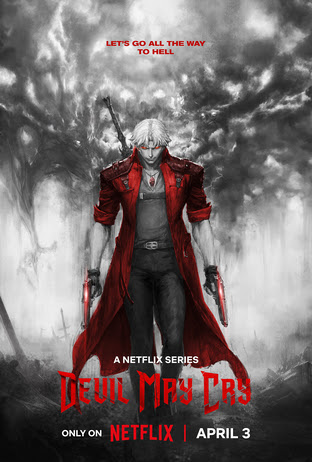
Based on the popular gothic-horror/action-adventure game developed by Capcom and created by Hideki Kamiya, Devil May Cry follows Dante, a demon-hunting mercenary on a mission to avenge his mother and brother’s deaths by eliminating demons. When a mysterious villain threatens to open the gates of Hell, Dante, a devilishly handsome and skilled hunter for hire, becomes humanity’s best hope for salvation. Caught in the middle of sinister forces at play between the human and demon realms, Dante remains unaware of the immense responsibility on his shoulders and finds that the fate of both worlds rests in his hands, or more specifically, around his neck…
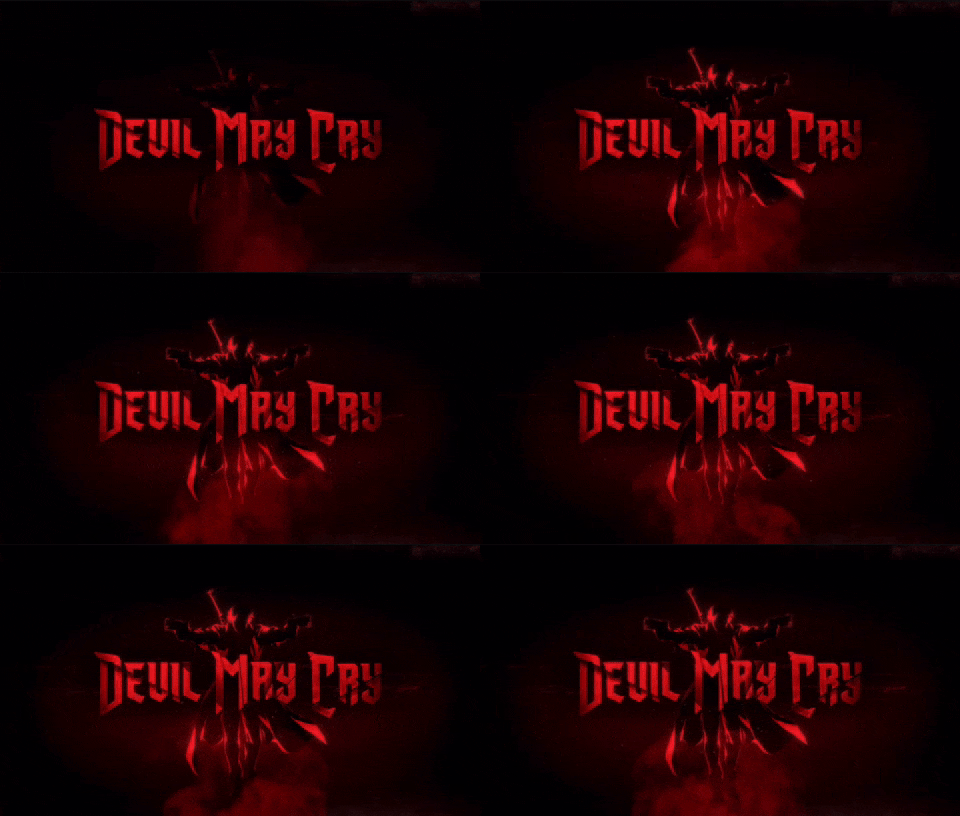
On the technical side, this adaptation was created by Adi Shankar (Castlevania and the Blood Dragon spin-off Captain Laserhawk), who serves as executive producer, and Alex Larsen as a writer for the series. The animation was done by South Korean animation studio Studio Mir (The Legend of Korra, The Witcher: Nightmare of the Wolf, Lookism, X-Men 97, and Mortal Kombat Legends: Scorpion’s Revenge). The Band Power Glove is the show’s composers, mostly doing slow-paced atmospheric covers of DMC game music, along with the end credits, while the Opening theme is “Rollin” by Limp Bizkit.
Since my late teens, I have remained an enormous longtime fan of this particular game franchise and have many fond memories playing the original 2001 PS2 game, along with its later sequels/prequels (minus the 2013 reboot). But also, as a fan, I must unfortunately say that this interpretation gave me mixed feelings… There are small moments of greatness, that are sometimes overshadowed by cringeworthy writing and scenes of shock-value that occasionally disrupt the flow, even as it explores more uncomfortable territory within its new narrative, and while the 2007 Devil May Cry by Madhouse remained relatively straightforward, this version exists in its own universe, setting itself apart by injecting political and scientific intrigue while exploring the global implications of demonic existence in a modern contemporary setting rather than the series’ usual tone or the anime’s more 1980s-inspired aesthetic.
The narrative itself is serviceable yet uneven, when the story kicks off with Vice President Baines (voiced by the late great Kevin Conroy) launching a government-backed investigation into the forces manipulating an impending apocalyptic event, one that Dante, the legendary demon hunter, is unknowingly entangled in. As the story unfolds, we get several character backstories, without being too distracting, complete with a standout episode, but more on that later. Throughout the series, there are fun Easter eggs to be spotted of various Capcom properties, whether through visual cues or direct verbal shout-outs. However, the plot doesn’t truly pick up until episode two, when an elite strike team sent by Baines decides to capture Dante, setting the stage for a series of high-energy action sequences. Yet, later episodes bring a clear escalation of stakes, propelling the narrative forward and embracing the stylish, over-the-top action that the franchise is known for, even if some of the social commentary felt a bit on the nose with whatever message it was conveying.
For the voice cast, Johnny Yong Bosch, who previously voiced “Nero” in later games, is taking the lead role of Dante in place of Dante’s long-time English voice actor, Reuben Langdon. But despite this, Johnny slips into the role and delivers the character’s snarky attitude, rockstar-like swagger, and bad-ass one-liners like he’s been waiting his whole life to say them, and gradually adds depth to the character as the story delves into more serious themes, even if Dante starts off having the mentality of a 20-something slacker who is still trying to figure himself out. Chris Coppla voices Enzo, an obscure supporting character from the DMC novels and manga whose appearance and performance appropriately give off sleazy and unscrupulous Danny DeVito vibes. Kevin Conroy’s final performance as Baines gives a subtle yet sinister performance, while Hoon Lee’s performance as the White Rabbit makes for a memorable villain with both him and Baines representing extremist ideologies from both sides, and finally Scout Taylor-Compton does a decent job with what she was given as Lt. Mary Arkham even if this version hasn’t fully embraced the “Lady” moniker yet (and if you’ve played the DMC3 game, you know what I’m talking about). These performances help anchor the series, making it watchable despite its uneven narrative and occasional questionable creative decisions.
On the subject of those questionable yet flawed choices, Netflix predictably can’t help themselves with their DEI checklist, cramming in political allegories on immigration, turning Dante, a beloved character who’s normally the epitome of stylish confidence into an occasionally fumbling, inexperienced slacker goofball, and rewriting Lady (still going by Mary Arkham) into an angry, mean-spirited “girlboss” whose dialogue sounds like her vocal cords were replaced with a foul-mouthed Viziepop character. While the series tries to modernize the Devil May Cry universe, these creative liberties often clash with the franchise’s established tone. And every other supporting character who gets introduced sometimes felt like mouthpieces for commentary rather than organic additions to the narrative. It’s not catastrophic, but these creative liberties continually remind viewers that the potential of having this be a sleek, fan-driven supernatural action story is instead occasionally preoccupied with ticking off narrative boxes.
Visually, Studio Mir delivers hyper-stylized action sequences reminiscent of early 2000s films like The Matrix, Equilibrium, and Underworld. The animation remains consistently strong throughout, with an occasional cel-shaded model here and there, reminiscent of Batman: Ninja. Out of the 8 episodes, episode 6 was easily one of the major standouts despite being an obligatory flashback episode. It’s not only longer in terms of running time, but it plays with its Alice in Wonderland references, complete with a brand new intro and a breathtaking departure from the usual aesthetic. Collaborating with Studio La Cachette, a French animation studio that has a decent track record of animated bangers, this nearly silent episode is an example of visual storytelling done right, as it offers a stunning yet emotional experience, complete with an exclusive track from Evanescence. On the subject, the soundtrack is curated with the energy of a high-intensity music video, pairing outlandishly fun action sequences with 2000s nu metal sensibilities in terms of quality, and even the promotional material included a hidden QR code leading to a random comedy bit that embraces the franchise’s playful side. Even so, some musical choices, with Adi Shankar symbolically sprinkling tracks from Green Day, Rage Against the Machine, and Limp Bizkit, can feel unnecessary and jarring, more like nostalgic symbolism than something that truly enhances the story.
Overall, Netflix’s rendition of Devil May Cry is an exciting, if imperfect, adaptation that makes a valiant effort in capturing the spirit of the games while delving into topical subjects not even the games themselves or the 2007 anime have ever touched upon before. It doesn’t always stick the landing, as the series occasionally feels uneven and sometimes came across as a pastiche Cliff’s Notes version of its source material with an occasional moment of shock value at times, (seriously nobody is safe in this universe, not even small children!) however the second half eventually makes up for this by delivering in spades with exceptional animation and engaging character development coupled with an unexpectedly polarizing and unforgettable season finale that uses an iconic Green Day song in a way that I never could’ve predicted. It was also confirmed that Tony Todd recorded dialogue for a posthumous role before passing away, though at the time of this review, there’s no word yet on which character he’ll voice, or when we can expect that performance in the future. But with the recent announcement of Season 2. We can only hope that Adi Shankar has plans meticulously laid out for future seasons that don’t keep us waiting for another 5-7 years…