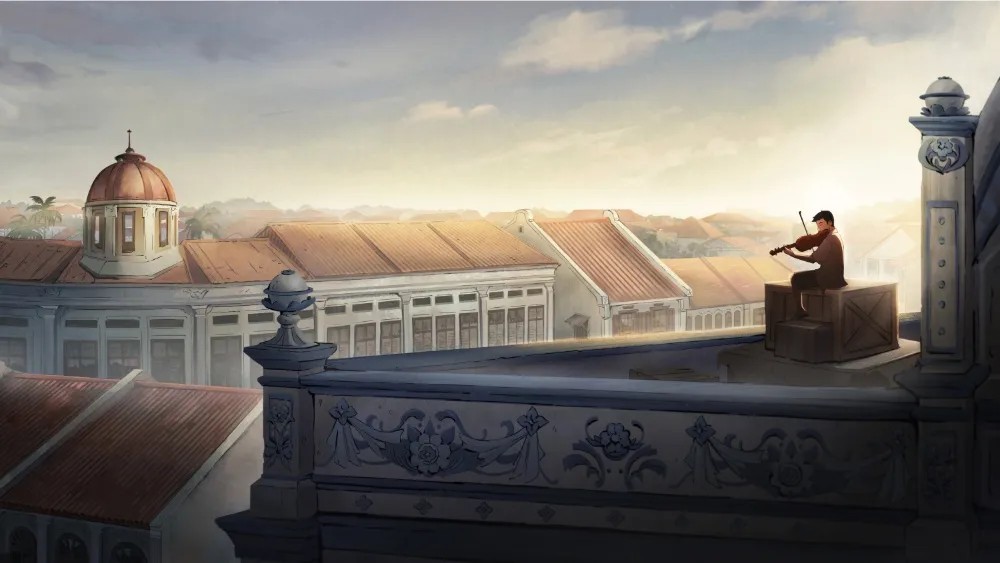
A Symphony of History: ‘The Violinist’ Makes History as Singapore’s First Annecy Main Competition Entry
In a landmark moment for global animation, the Singapore-led feature The Violinist has been officially selected to compete for the prestigious Cristal Award at the 2026 Annecy International Animation Film Festival. Directed by Singaporean filmmaker Ervin Han and veteran Disney animator Raul Garcia (Aladdin, The Lion King), the film represents a decade-long journey to bring a deeply local story to a global stage.
A Story Rooted in Memory and War
The Violinist is an epic historical drama that spans the 20th century, primarily set against the backdrop of British colonial Singapore and the Japanese Occupation.
The narrative follows two childhood friends, Fei and Kai, whose shared passion for music is torn apart by the outbreak of World War II. After Kai joins the resistance and disappears, the story follows Fei’s decades-long journey as a concert violinist, using her music as a beacon to find her lost friend. The film explores universal themes of resilience, displacement, and the enduring power of memory.
The voice cast features some of Singapore’s most recognizable talent, including Tan Kheng Hua (Crazy Rich Asians) as the older Fei and Fang Rong as her younger self, alongside Adrian Pang and Ayden Sng.
Music as the Protagonist
As the title suggests, music is the heartbeat of the film. The original score was composed by Golden Horse Award-winner Ricky Ho, with additional music by Isabel Latorre. To ensure authenticity, the lead violin performances were recorded by acclaimed Singaporean violinist Joy Yong, bridging the gap between the film’s visual artistry and its auditory soul.
Breaking New Ground for Southeast Asia
For director Ervin Han, the selection at Annecy is the culmination of a vision that began with his 2015 short film The Violin. Speaking on the achievement, Han noted that because Singapore does not have a traditional animated film industry, the project required years of research and international networking to secure the necessary scale and ambition.
The selection is seen as a “step-change” for Southeast Asian animation, signaling to the world that the region is capable of producing mature, complex, and high-quality 2D hand-drawn features that resonate with international audiences.