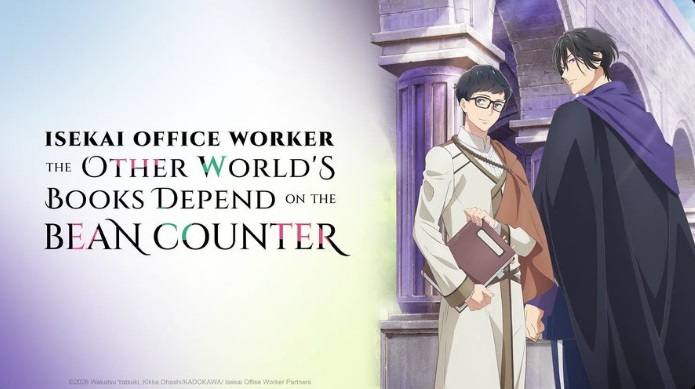
English Dub Season Review: Isekai Office Worker: The Other World’s Books Depend on the Bean Counter Season One
Based on the light novel series by Yatsuki Wakatsu and illustrated by Kikka Ohashi, the story follows Seiichirou Kondou, an overworked office employee who is unexpectedly transported to the magic-filled Romany Kingdom after being caught in a summoning ritual; rather than accepting a life of luxury as compensation, he insists on working and joins the Royal Accounting Department, where his sharp instincts and relentless work ethic quickly push him to address the kingdom’s financial mismanagement, though the new world proves dangerous after a near-fatal incident leaves him saved by Aresh Indolark, the composed captain of the Third Royal Order known as the “Ice Prince,” and as the two navigate their clashing personalities and values, their relationship gradually deepens into something more meaningful, ultimately shaping not only their own lives but the future of the kingdom itself, while to support his intense work ethic Seiichirou develops a habit of ingesting magical energy drinks without realizing the risks, eventually suffering a “mana overdose” that worsens when Aresh uses healing magic due to Seiichirou’s lack of tolerance, leaving physical contact and sexual intercourse as the only viable method to stabilize his condition.
On the technical side, this anime adaptation was produced by Studio Deen and directed by Shinji Ishihara, with Akira Yamada serving as assistant director, Yoshiko Nakamura handling series composition, Maki Fujii designing the characters, and Megumi Ōhashi composing the music. The opening theme song is “Magic”, performed by Kobore, while the ending theme song is “Back to Back”, performed by Win Morisaki.
The series takes a surprisingly unconventional approach to both the isekai and boys’ love romance genres by blending fantasy, workplace management, political intrigue, and personal relationships into a story that feels more ambitious than its premise suggests. Instead of following the usual overpowered protagonist formula, it focuses on Seiichirou Kondou, a hardworking salaryman accidentally summoned to another world alongside a young girl named Yua, the chosen “Holy Maiden”. His greatest strength is not combat ability, but his analytical mindset, organizational skills, and dedication to solving problems through logic and experience. While the story remains fairly straightforward, its focus on politics, world-building, and everyday problem-solving helps it stand apart from more conventional isekai series.
The romance is where the series becomes much more complicated. I appreciate that the relationship is not built entirely around physical attraction, and the kissing scenes and implied intimacy are handled with enough restraint that they never feel excessive. What makes these moments more interesting is the in-world explanation through the magical acclimation system, giving the romance a logical purpose instead of making the fan service feel randomly inserted. However, the emotional progression does not always keep pace with the physical relationship. Seiichirou initially views the intimacy as a necessity rather than genuine affection, while Aresh clearly attaches deeper feelings to it. This imbalance, along with Aresh’s possessive behavior and occasional disregard for Seiichirou’s boundaries, makes parts of the romance feel more uncomfortable than romantic. The concept is interesting, but the execution could have handled themes of consent and emotional dependency with more depth.
Outside of the romance, the writing is a mixed experience. Seiichirou is easily the strongest part of the series thanks to his grounded personality, intelligence, and refreshing lack of typical isekai protagonist traits. However, the world around him often feels underdeveloped despite introducing interesting ideas involving politics, magic, and the summoning process. Many of these concepts are introduced without receiving the exploration they deserve, and the kingdom sometimes feels too incompetent simply to highlight Seiichirou’s abilities. I also appreciated that Yua was not forgotten after the initial setup, as later episodes give the Holy Maiden a decent character arc that allows her to develop beyond her original role as the person meant to save the world they’re both stuck in. I would have also liked more focus on Seiichirou’s internal conflict over whether he truly wanted to return home or embrace the new life he was building. While I have no issue with LGBTQ relationships and have enjoyed other works within similar genres, the biggest weakness here is that the story can become surprisingly uneventful. Even unique ideas can struggle when the central appeal revolves around a protagonist being exceptionally good at accounting and legal paperwork.
In terms of sounds and visuals, the anime is serviceable but rarely impressive. The animation gets the job done, though magical effects and important moments often lack the impact they could have had. The character designs are appealing, and the voice acting fits the cast well, but the presentation rarely leaves a lasting impression. The soundtrack complements the tone without becoming a standout feature. Ultimately, the adaptation relies more on its premise, character interactions, and atmosphere than its visual presentation. Nothing about the production is particularly bad, but it also does little to elevate the series beyond its core ideas.
Overall, this series ended up being a more enjoyable surprise than expected. Its combination of fantasy, workplace problem-solving, political elements, and boys’ love romance gives it a distinct identity within the isekai genre. Seiichirou is a likable and refreshing protagonist who carries much of the story through his personality and intelligence, while Yua’s later development helps strengthen the supporting cast. However, uneven world-building, inconsistent pacing, average production values, and an underdeveloped romance prevent it from reaching its full potential. The magical acclimation system is a creative way to incorporate intimacy into the story, but the emotional connection needed more time to develop naturally. Even with its flaws, the series remains memorable because it tries something different, and that willingness to take a unique approach makes it worth experiencing.