Review: A Magnificent Life
Overview (Spoilers Below):
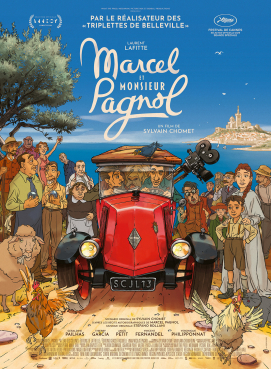
The film follows the life of 60-year-old Marcel Pagnol (Laurent Lafitte), an acclaimed playwright, novelist, and filmmaker, who is visited by a vision of his childhood self.
Our Take:
In a time when Hollywood has consistently neglected theatrical 2D animation, we couldn’t help but be grateful that other countries treat the format more fairly than America. Most notably, Japan has given us plenty of anime movies that warrant the theatrical experience, particularly “Demon Slayer: Infinity Castle”. Another example worth noting comes from France, where it released a traditional animated film centered on one of the country’s well-known auteurs, Marcel Pagnol. Never heard of him? Neither have I, which is why this film exists to remind us of his existence.
A Magnificent Life was written and directed by Sylvain Chomet, who is best known for helming the animated classics “The Triplets of Belleville” and “The Illusionist”. Following the traditional biographical narrative, the movie traces the life and career of Marcel Pagnol, who became one of the world’s most creative artists from the 1930s to the 1950s. However, the actual story is set in 1955, when Pagnol is tasked with writing about his childhood for ELLE magazine. But his passion was called into question when his memory failed him, and his last two plays weren’t as well-received as his earlier works. When he encounters his younger self, Pagnol is given the opportunity to recall the memories he cherishes most.
One thing I appreciate about biographical movies is the exploration of a specific celebrity and what makes them tick. It’s not just the projects they created that shaped our culture, whether novels, music, or movies, but also their personal lives, whose experiences led them to the development of these iconic arts. It also helps when a genre provides a refreshing perspective on the narrative to highlight a person’s career, based on their own creativity. A Magnificent Life is another such example of this structure, as it uses traditional animation to delve into the events that shaped Marcel Pagnol into the beloved auteur he became. Does this technique revolutionize the typical biopic narrative? Surprisingly, no.
Regarding the story, A Magnificent Life is yet another biopic that skims through the crucial events surrounding a certain celebrity, which, in this case, is Pagnol and his transition from playwriting to filmmaking. It follows the basic elements many of us have seen countless times from other biopics, but some of them lack the emotional heft needed to elevate its depiction of life and art. Pagnol experiences plenty of ups and downs throughout his life, especially in his career, but they also shape who he becomes in his 60s and lead him to create some of France’s finest works. It reflects that the greatest art can come from the creator’s own life. While these themes are well-intentioned for an animated film like this, Chomet’s screenplay doesn’t quite carry the same inventive spirit as his previous animated features.
But at the very least, it benefited from its animation style. Like Chomet’s previous animated movies, primarily “The Triplets of Belleville”, A Magnificent Life offered a presentation consisting of highly detailed yet somehow uncanny character designs that match the realism of their live-action counterparts. While they can take a bit to get used to, the characters offer plenty of humanity and fluidity in their designs, which coincide with the artistry and beauty of the film’s European settings. The 2D animation also blended exceptionally well with the CGI regarding camera movements. Despite not offering much else in its style to complement its nonlinear storytelling, the film further proves that animation can still create something sublime that a live-action version could not.
When it comes to its biopic tropes, A Magnificent Life is anything but magnificent. However, it does provide a suitable yet formulaic exploration of Marcel Pagnol and the memories that shaped him. With its respectable presentation and voice cast, including Laurent Lafitte as Pagnol, this is another addition to the biographical genre that’s not anything special, but is enjoyable enough to admire the person and their accomplishments. It also showcases the thriving success of 2D animation outside the United States through a director’s vision, something Hollywood still has yet to understand.