English Dub Season Review: To Your Eternity Season 3
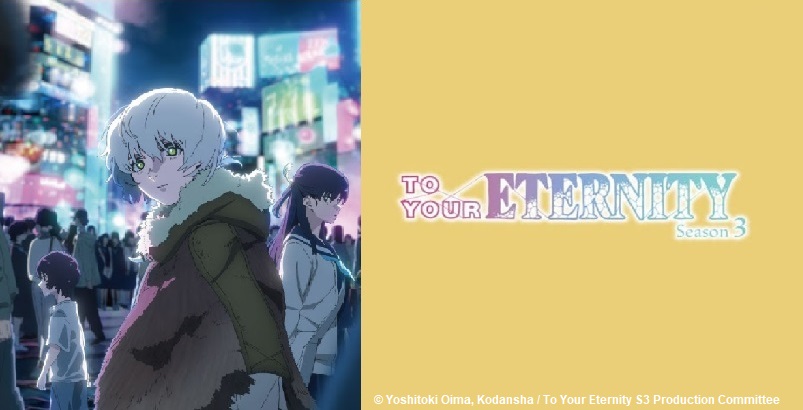
Long after the events of Season 2, Fushi awakens from a long hibernation as he navigates the complexities of the modern world alongside the many companions he has brought back to life, struggling to balance his desire to make everyone happy with the realities of a vastly evolved society. Taken in by Yuki, a curious and determined high schooler, Fushi is introduced to new allies and adversaries alike, including Mizuha, a descendant of Hayase with her own complicated circumstances, her overbearing mother, Izumi, and Satoru, the human reincarnation of his creator. The shift to a present-day setting gives the story a distinctly different tone, presenting challenges that feel more grounded yet morally complex, especially as the Nokkers re-emerge not as pure enemies, but as beings seeking coexistence with humanity, forcing Fushi to confront unfamiliar dilemmas in a rapidly changing world…
On the technical side, Season 3 was a joint effort between Studio Massket and Studio Drive to animate the third season, with Sōta Yokote directing and Sayama returning from the second season as chief director, with the rest of the staff and cast reprising their roles, such as Shinzō Fujita handling series composition, Koji Yabuno designing the characters, and Ryo Kawasaki composing the music. The opening theme song is “Your Eternity”, performed by Perfume, while the ending instrumental theme and its later remix version of “Recollections” was composed by Masashi Hamauzu.
Five centuries into his journey, Fushi the Immortal finds himself in a modern world filled with technology, social rules, and challenges he struggles to comprehend. Early in this era, he encounters Yuki and his family, who help Fushi and his resurrected friends adjust to contemporary life, guiding them through daily routines and social expectations. Their support gives Fushi a foothold in this new timeline while he continues to meet figures tied to his past: Mizuha, a descendant of a long line connected to him, her controlling mother Izumi, and Satoru, the human incarnation of the godlike Beholder. These relationships set the stage for both personal growth and philosophical dilemmas in this unfamiliar world.
The Nokkers sort of return, but this time claiming they want to coexist with humanity. The series attempts to explore whether destructive beings can change and whether Fushi’s empathy can guide them toward redemption. Unfortunately, this arc is poorly executed. This redemption trope used across media for the last 20+ or so years is overdone, insipid garbage that’s misleading and ultimately frustrating. It sends a dangerous message: that evil or destructive beings can always be forgiven, that even inherently harmful people or monsters are redeemable, and that their misdeeds can be excused if the story declares so. In reality, many evil acts stem from mentally disturbed individuals who are not seeking forgiveness, and not all moral wrongs are correctable. By compressing the Nokkers’ potential moral turnaround into a few episodes, the show trivializes their destructive history, undermining both the stakes and the philosophical weight the arc could have carried.
Mizuha’s character arc runs into similar issues, though with a bit more nuance in certain areas. The story tries to frame her as a deeply troubled and sympathetic figure, but often leans too heavily on that angle while glossing over the severity of her actions. However, one of the more compelling elements comes from her mother’s backstory, which stands out as one of the most tragic aspects of the season. It adds important context to how Mizuha was raised, highlighting a cycle of generational trauma shaped by their family’s long-standing connection to Hayase’s Guardian cult and the Nokkers. This layer attempts to reframe Mizuha in a more sympathetic light, showing how her environment and upbringing contributed to who she becomes. Even so, the execution struggles to balance sympathy with accountability, leaving her arc feeling conflicted rather than fully realized.
Visually and from a production standpoint, the season holds up impressively despite the studio shift, maintaining consistent and expressive animation that captures both subtle emotional beats and the tension of morally gray conflicts with precision. Direction and character expressions do much of the heavy lifting, clearly conveying Fushi’s confusion, internal struggle, and evolving perspective, while the soundtrack leans into a calmer, more atmospheric tone that fits the modern setting and enhances reflective moments without overshadowing them. The series continues to shine through its presentation, with striking sequences like Mizuha’s eerie moments in the abandoned tunnel, isolated encounters filled with quiet tension, and the flash-forwards showing the characters’ futures delivering strong emotional resonance, proving that even when the narrative execution stumbles, its visual storytelling and overall atmosphere remain compelling.
Overall, Season 3 of To Your Eternity was a thought-provoking yet uneven chapter, exploring the challenges of understanding humanity in a modern world. While Mizuha’s story moments and a major subplot involving the Nokkers feel somewhat rushed and keep me from giving this a higher rating, Fushi’s personal growth with support from Yuki and his friends remains engaging, and the season highlights emotional bonds, moral complexity, and personal struggles, leaving the story open-ended and primed for a potential Season 4 that could continue following Fushi’s journey in a world that has drastically changed.