English Dub Season Review: The Irregular at Magic High School Season 3
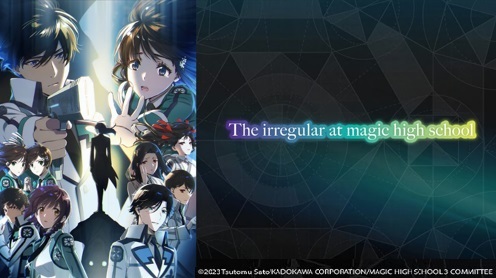
Based on the light novel series by Tsutomu Satō and illustrated by Kana Ishida, The Irregular at Magic High School continues with Tatsuya Shiba navigating a world where the anti-magic movement is gaining dangerous momentum. Warned by the Yotsuba family, he takes calculated measures to counter the schemes of corrupt politicians and manipulative journalists, successfully repelling an initial attack that sought to frame First High School as a covert military training ground. Yet Tatsuya’s most formidable adversaries have yet to reveal themselves, and if he hopes to maintain a peaceful life alongside his sister Miyuki, he must once again prove that no one can outwit him.
On the technical side, this continuation was produced by Eight Bit under the direction of Jimmy Stone, with original story by Tsutomu Satō and character designs by Kana Ishida. Music is composed by Taku Iwasaki, known for his work on Black Butler, Bungo Stray Dogs, and Gurren Lagann. The series features an opening theme, “Shouted Serenade” by LiSA, and ending themes including “recall” by Kairi Yagi, “Snow Noir” by Sangatsu no Phantasia, and “Aster Bouquet” by ASCA
The Irregular at Magic High School began with Season 1 as a thrilling blend of high school life and over-the-top magical combat, introducing Tatsuya Shiba as a nearly invincible protagonist. From the Nine Schools Competition to the Yokohama incidents, the season emphasized Tatsuya’s genius, strategic brilliance, and teamwork, making it a satisfying mix of spectacle and character interaction. Season 2 continued to raise the stakes, with foreign threats, supernatural rivals, and brief moments where Tatsuya faced worthy opponents like Parasite. However, both seasons largely ignored the political and familial depth of the Yotsuba Clan, focusing instead on battles and the power dynamics among friends and schoolmates.
Season 3 pivoted to a darker, more political narrative, exploring magicians as tools and weapons while deepening the intrigue between military factions and magical families. This season introduced new characters, clans, and threats, forcing Tatsuya to rely on allies more than ever, especially in arcs like the Ancient City Insurrection and the Steeplechase. While the plot was dense and occasionally slowed by heavy exposition, it delivered strategic confrontations—most notably against Zhou—that were some of the most engaging moments in the series. Miyuki and Tatsuya’s relationship also developed meaningfully, although her obsessive tendencies sometimes undercut the story. Compared to the sheer spectacle of Season 2, Season 3 traded “wow factor” for political depth and worldbuilding.
Storytelling-wise, Season 3 addressed earlier flaws with more coherent scene transitions, detailed character interactions, and a focus on the Yotsuba family dynamics. Supporting characters, like Kokonoe Yakumo and Kudou Minoru, had standout moments, though much of the secondary cast remained underdeveloped. The season covered four light novel volumes in just 13 episodes, which led to rushed pacing and some missing context, but the adaptation stayed faithful to the source overall. While the dialogue-heavy narrative sometimes dragged, it provided necessary political and strategic context, giving the world a more grounded complexity than prior seasons.
Animation and music were definite highlights. 8-Bit delivered cleaner, more vibrant visuals, with improved camera angles, expressive facial animations, and fluid magic battles—particularly in Episode 1’s opening fight. While some 3D CGI elements appeared, they rarely detracted from the experience. Taku Iwasaki’s score maintained the series’ dramatic tone, and LiSA’s opening coupled with ASCA’s ending theme provided excellent energy and transitions. Storyboard execution, scene transitions, and attention to character expression elevated the narrative flow, making the world feel more alive despite pacing issues.
Overall, Season 3 is a mixed bag: it deepens Mahouka’s political and familial layers, showcases Tatsuya’s strategic brilliance, and offers meaningful character growth, but it struggles with rushed pacing, underwhelming secondary arcs, and dialogue-heavy exposition. Longtime fans will appreciate the spotlight on the Yotsuba family and the expanded worldbuilding, while the animation, music, and narrative cohesion remain strong highlights. Though it may not reach the excitement or originality of the first two seasons, it sets the stage for future stories, along with the recent announcement of an upcoming anime movie, The Irregular at Magic High School: Yotsuba Succession Arc. It promises to further explore these threads. Despite its flaws, the series endures as a staple of urban fantasy and a must-watch for fans of overpowered protagonists and intricate magical politics.