English Dub Season Review: The Irregular at Magic High School Seasons 1 & 2
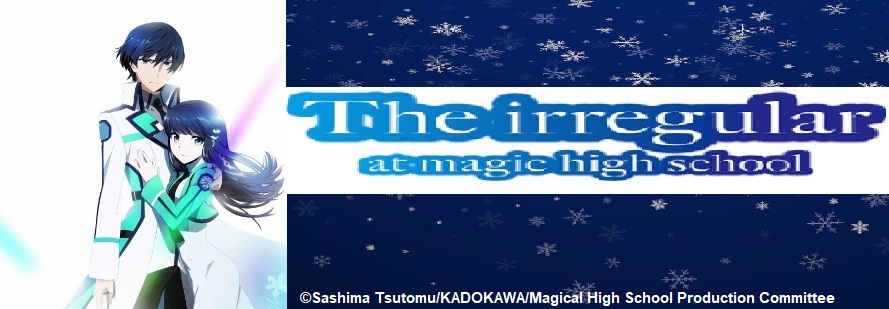
Based on the light novel series by Tsutomu Satō and illustrated by Kana Ishida, The Irregular at Magic High School is set in a near-future Japan where magic has been fully systematized as a form of technology. Spells are cast using Casting Assistant Devices powered by Psions, treating magic as a technical discipline rather than mysticism. The story follows siblings Tatsuya and Miyuki Shiba as they enroll at First High School, an elite academy that rigidly segregates students by ability into the elite First Course “Blooms” and the inferior Second Course “Weeds.” While Miyuki is immediately recognized as a prodigy, Tatsuya is branded as magically inept and relegated to the lower tier despite secretly possessing exceptional combat ability, advanced technical expertise, and unconventional magic that defies the school’s evaluation system. As they navigate school life while concealing their ties to the powerful Yotsuba clan, Tatsuya’s existence steadily exposes the flaws, hypocrisy, and instability of a society obsessed with rankings and surface-level talent.
On the technical side, this anime adaptation was produced by Madhouse and directed by Manabu Ono, along with original character designs by Kana Ishida and soundtrack music by Taku Iwasaki. Season One uses four pieces of theme music: two opening themes and two ending themes. The first opening theme is “Rising Hope” by LiSA while the first ending theme is “Millenario.” by Elisa. The second opening theme is “Grilleto” by Garnidelia, while the second ending theme is “Mirror” by Rei Yasuda. Season Two on the other hand was was animated by Studio 8-Bit, with Risako Honda directing and Taku Iwasaki handling the music, taking over from the first season’s production and directed by Risako Honda. ASCA performed the opening theme song “Howling”, while Miki Satō performed the ending theme song “Na mo Nai Hana”.
Set in a post–Third World War future of 2095 where magic has been systematized into a scientific discipline, The Irregular at Magic High School presents a world that blends political tension, technological mysticism, and rigid social hierarchy. At its core are siblings Tatsuya and Miyuki Shiba, whose enrollment at First High School immediately disrupts the institution’s strict Bloom-and-Weed caste system. While Miyuki is celebrated as an elite prodigy, Tatsuya is dismissed as inferior an assumption the series wastes little time dismantling. Across both seasons, the narrative repeatedly challenges institutional authority, discrimination, and national power structures, framing the siblings less as underdogs and more as destabilizing forces in a carefully ordered society.
Season 1 is heavily arc-driven and exposition-dense, devoting extensive runtime to explaining its magic-as-science framework, political factions, and societal mechanics. This deliberate pacing is a double-edged sword: it lends the world a sense of realism and depth, but frequently stalls narrative momentum and overwhelms viewers with technobabble. Conflicts often follow a predictable structure school events disrupted by extremist groups yet the strength of the season lies in its concepts rather than execution. By contrast, Season 2 known as the “Visitor Arc,” tightens its focus, shifting away from pure academic settings toward broader geopolitical and familial stakes.
The characters remain one of the series’ most polarizing elements. Tatsuya is unapologetically overpowered, functioning less as a traditional protagonist and more as an immutable constant who bends every situation in his favor. Rather than evolving emotionally, he is explored retroactively through revelations about his past, reframing his emotional detachment as tragic rather than shallow. Miyuki, meanwhile, is defined almost entirely by her devotion to her brother, a dynamic that oscillates between sincerity and borderline incestuous due to how weirdly obsessed she is of him. The supporting cast particularly figures like Mayumi Saegusa offers flashes of personality and potential, but most are confined to functional roles, rarely receiving the development needed to elevate them beyond narrative accessories.
From a production standpoint, the series is consistently polished. both studios respectively deliver fluid action sequences, clean character designs, and striking magic visuals, particularly through its intricate spell effects and CAD interfaces. The aesthetic leans toward sleek futurism rather than fantasy excess, reinforcing the show’s sci-tech identity. Musically, the series is equally strong: its openings are memorable and tonally appropriate, while the OST blends electronic and orchestral elements to underscore both tension and spectacle. Voice acting is uniformly solid, with performances that lend credibility to even the most exposition-heavy scenes, though certain recurring vocal tics most notably from Miyuki may test patience over time.
Overall, The Irregular at Magic High School is a deeply flawed yet undeniably distinctive series that sits uncomfortably between ambition and indulgence. Its world-building, production quality, and thematic ideas often outshine its storytelling discipline and character writing, resulting in an experience that can be either fascinating or exhausting depending on your tolerance. For audiences drawn to overpowered protagonists, dense lore, and meticulous systems, it offers a uniquely structured take on the genre. It may never fully realize its potential, but for better or worse, it remains memorable precisely because of how boldly and divisively it commits to its vision.