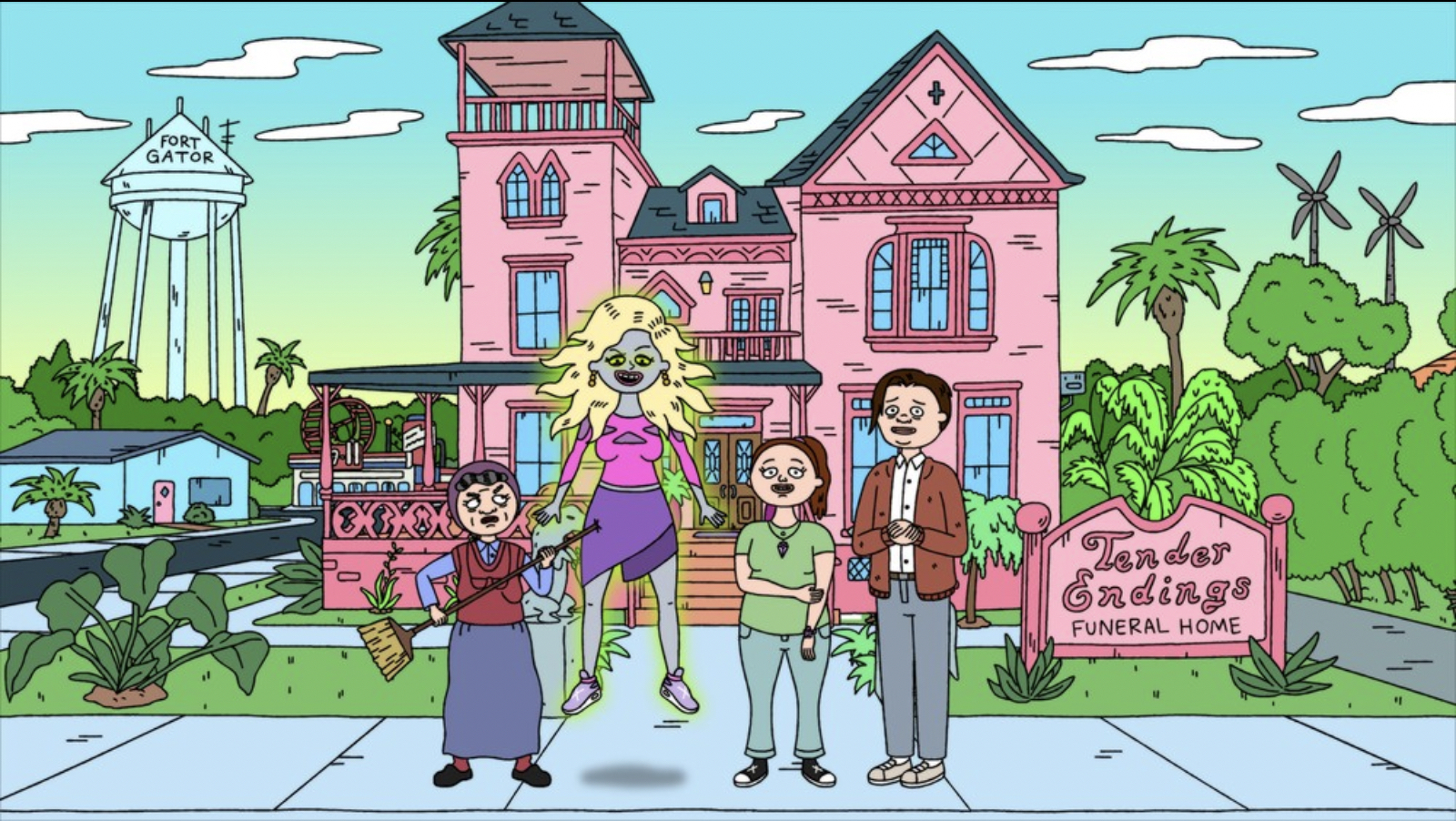
Review: Teenage Euthanasia “Dada M.I.A.”
Overview:
Navigating family drama can be even more difficult when it’s full of question marks. The Fantasy family is never lacking when it comes to female energy, but it’s the absence of masculinity in the lives of Annie and the rest of her family in “Dada M.I.A.” Long dormant confusion over the men of the Fantasy family triggers a probing journey that examines this schism. Annie and Pete long for paternal answers, yet they develop even more questions once they begin to look into what makes them who they are, both in terms of learned behavior and in a literal, genetic sense.
Our Take:
Teenage Euthanasia has never shied away from the fact that it’s an animated series that showcases three strong generations of women. Even the show’s informative opening credits effectively crystalize the comedy’s female-heavy perspective. The storylines that have dominated the first season of Teenage Euthanasia typically narrow in on the idiosyncrasies that define family, like when the Fantasy clan bring out the best in each other and when their behavior is communally toxic. In this sense, it’s incredibly appropriate that the first season finale for Teenage Euthanasia, “Dada M.I.A.,” deconstructs the Fantasy family in its biggest way yet, but that it also examines if they’re actually as fractured as they think that they are or if the unconventional dynamic that they’ve settled into is what the most complete version of their family looks like.
The chaotic nature of life may sometimes make it feel like people are just pieces moving around without agency on a board game, but “Dada M.I.A.” completes this metaphor in a very literal fashion with “Daddy, It’s Me (Florida Edition).” The overarching premise in this finale brilliantly meshes together paternity test anxiety with the “Game of Life,” which is such a PFFR-esque idea. “Daddy, It’s Me” literally feels like it fell out of a lost Wonder Showzen sketch.
“Dada M.I.A.” is interested in emotional territory, but the episode also leans into the tech-based nature of its board game, like it’s a more invasive and disrespectful version of Jumanji. It’s the perfect tone for this style of story and while there are constant Jumanji references that get made, the episode could have gone even further in this direction as potential father figures flood the real world. It’d be a natural extension of the future tech that’s often highlighted in each episode, even when it’s innocuous and just in service of a weird gag.
This season finale is sound in a structural sense, but there’s also plenty of glorious non-sequitur strangeness that creeps up in the corners of “Dada M.I.A.” For instance, there’s a fun sight gag where a bottomless Trophy bonds with Annie as they begin to embrace their paterni-tastic adventure. Trophy’s crotch is blurred out with a mosaic pattern, but this censorship extends to her hips and other sections of the lower half of the body, which elicits hilarious confusion over just what’s being obscured here. This season finale is full of odd moments like this that get a lot of mileage out of a simple gag, which in a way is emblematic of the tenor of Teenage Euthanasia as a whole.
”Self-Inflicted Gunshot Bloopers” is another excellent example where the series fully embraces its indicting Idiocracy-level representation of society and their dominant forms of “entertainment.” Even the community’s 7-11 is facetiously named 9-11 and isn’t free of this roving commentary. Jo Firestone, who voices Annie, also pens this exceptional season finale, which proves that she understands the motivations and humor behind the world of Teenage Euthanasia as well as she’s able to tap into Annie’s freefloating anxiety.
The first season of Teenage Euthanasia confidently concludes with “Dada M.I.A.,” another episode that accentuates the sweet, strange nature of the series. The larger themes that it explores may come across as somewhat repetitive in contrast to the rest of the season, but there’s a strong energy to the finale that uses these similarities to better inform what’s come earlier in the season. There’s a sense of accomplishment as “Dada M.I.A.” comes to a close and Annie, Trophy, and the rest of the characters feel like they’ve become slightly more fulfilled, even though Teenage Euthanasia is episodic in nature with not much of an arc to to it. This finale doesn’t stoop to a gratuitous cliffhanger or contrived theatrics and instead it just focuses on the importance of family and the unique relationships that make each Fantasy member special. It’s not necessarily a finale or a season that demands more episodes, but there’s a comfortable confidence that allows Teenage Euthanasia to unabashedly be itself and not worry about the consequences.
And speaking of consequences, you can get pregnant on a Tilt-A-Whirl. Don’t tempt carny science…