English Dub Season Review: The Ghost in the Shell 2026
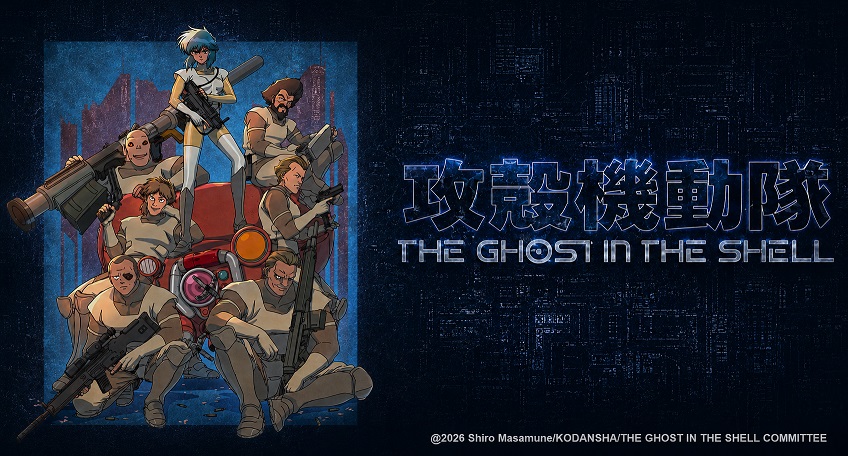
Based on the beloved Japanese cyberpunk manga series written and illustrated by Masamune Shirow, the story is set in the year 2029, when advances in cybernetic technology have transformed society. During a raid on a meeting involving a foreign representative suspected of corruption and criminal activity, Public Security officer Daisuke Aramaki encounters the enigmatic full-body cyborg Motoko Kusanagi. After proposing the creation of a specialized unit capable of preventing emerging threats before they escalate, Kusanagi is tasked by Aramaki with proving the concept through an investigation. Their collaboration ultimately leads to the formation of Public Security Section 9, also known as the “Shell Squad.” As the team takes shape, an international conspiracy begins to unfold, centering on the elusive hacker known only as the Puppet Master, whose true motives could reshape the future of both humanity and technology.
On the technical side, the anime adaptation was produced by Science SARU, with Moko-chan serving as director and EnJoe Toh handling the series composition and screenplay. Shuhei Handa provided the character designs and served as chief animation director, while Taisei Iwasaki, Ryo Konishi, and Yuki Kanesaka composed the series’ music. The production committee consists of Science SARU, Bandai Namco Filmworks, Kodansha, and Production I.G. The opening theme, “Go Ghost,” is performed by King Gnu, while the ending theme, “Blue,” is performed by Millennium Parade featuring Saya Gray and Daniel Caesar.
The Ghost in the Shell franchise has long stood among the upper echelon of Japanese anime, with the 1995 Anime film, the Stand Alone Complex series, and even the Rupert Sanders-directed live-action film that famously starred Scarlett Johansson becoming defining works within anime, pop culture, and cyberpunk science fiction. And as someone experiencing the franchise for the first time through this 2026 adaptation while still being familiar with its previous iterations, I was particularly interested in seeing how Science SARU would approach the original manga. Rather than trying to imitate the tone of earlier adaptations, the series returns directly to Masamune Shirow’s work, faithfully recreating its stories, characters, humor, and eccentricities. It follows Major Motoko Kusanagi and Section 9 as they tackle everything from cybercrime and criminal investigations to political conspiracies, gradually expanding from relatively episodic stories into a larger narrative involving artificial intelligence, consciousness, and the nature of the “ghost.” This makes it arguably the most direct animated interpretation of Shirow’s manga, although newcomers may find themselves thrown into its world with considerably less explanation than expected.
The writing is also where the adaptation becomes most divisive. Instead of treating Ghost in the Shell as relentlessly serious cyberpunk, Science SARU embraces the manga’s humor, exaggerated expressions, and more playful characterization. Kusanagi is considerably more expressive and mischievous than the stoic Major seen in earlier adaptations, while Batou gets to lean much harder into his comedic side. I think this tonal balance works because the humor gives the series room to breathe before it dives into heavier philosophical and political material. For the first several episodes, the series settles into a familiar “criminal/crime of the week” formula, with Section 9 dealing with a different case before moving on to the next. However, by episode 7, things begin taking a much more serious direction as the individual stories start connecting to larger political and philosophical developments. The problem is that the ten-episode runtime forces an enormous amount of information into a very limited space, especially during the latter half.
However, this 10-episode series is far from perfect, as this adaptation’s faithfulness also comes with some frustrating compromises. Shirow’s original author notes are incorporated directly into the anime as Japanese text appearing in the bottom-left corner, providing additional information about the world, technology, terminology, and characters. Because of this, having the subtitles turned on is essentially required to get the full experience, but keeping up with the dialogue while simultaneously reading these additional notes can become surprisingly overwhelming. Important information can easily be missed when your attention is divided between multiple parts of the screen, occasionally forcing you to either pause or rewind just to make sure you caught everything. The anime also noticeably tones down the manga’s nudity and sexual content, including the removal of visible nipples and the more explicit depiction of female robot nudity. Most notably, the Major’s random sexual encounter on a boat is heavily toned down compared with the manga, retaining the basic idea of the scene while removing much of its explicitness. While some of this censorship is understandable for a television production, it stands out in an adaptation otherwise committed to preserving Shirow’s material. The fictionalized country names are another questionable decision, particularly because the story gradually places greater emphasis on geopolitics. The dialogue can also move so quickly that certain episodes require pausing and rewinding simply to keep up with the terminology, character motivations, and political relationships being discussed. There are several genuinely outstanding episodes, but the pacing occasionally sacrifices clarity in its attempt to fit so much of the manga into one season.
Visually, Science SARU has delivered some of the strongest work of the studio’s recent output. Instead of attempting to imitate a 1990s anime, the production preserves Shirow’s cartoony character designs, expressive faces, and distinctive visual language while combining them with modern animation and compositing techniques. Director Mokochan’s dedication to hand-drawn animation is especially admirable, with the production avoiding generative AI and emphasizing traditional animation rather than letting technology dictate the visual style. The series does still utilize 3D technology in certain areas, but it is integrated so naturally with the hand-drawn work that it rarely feels intrusive. The action is fluid, the choreography is excellent, and the overall presentation has an impressive amount of personality. The English dub is another major highlight, with Suzie Yeung bringing a great balance to Kusanagi’s hotheaded, comedic personality and her more introspective qualities. Bill Butts is especially good as Batou, embracing the character’s humor and larger-than-life personality in a way that makes him one of the standout performances in the dub, while SungWon Cho and Nick Apostolides also do excellent work as Aramaki and Togusa, respectively. The soundtrack also complements the atmosphere nicely, even if it does not leave quite as lasting an impression as some of the franchise’s previous musical identities.
Overall, Ghost in the Shell 2026 has been a fascinating introduction to a franchise I had known about for years but had never actually experienced for myself. Coming into this as someone familiar with the reputation of the 1995 film, Stand Alone Complex, and the other previous interpretations, I appreciated that Science SARU chose to give Shirow’s original manga its own identity rather than simply recreating what came before. It certainly has its flaws, but there is enough creativity, personality, and ambition here to make me curious about exploring the rest of the franchise. The last episode also leaves the door open for another season, although at the time of this review, it remains uncertain whether that will actually become a reality. But for anyone new to this franchise, I’d say it was a pretty memorable one.