English Dub Season Review: Needy Girl Overdose Season One
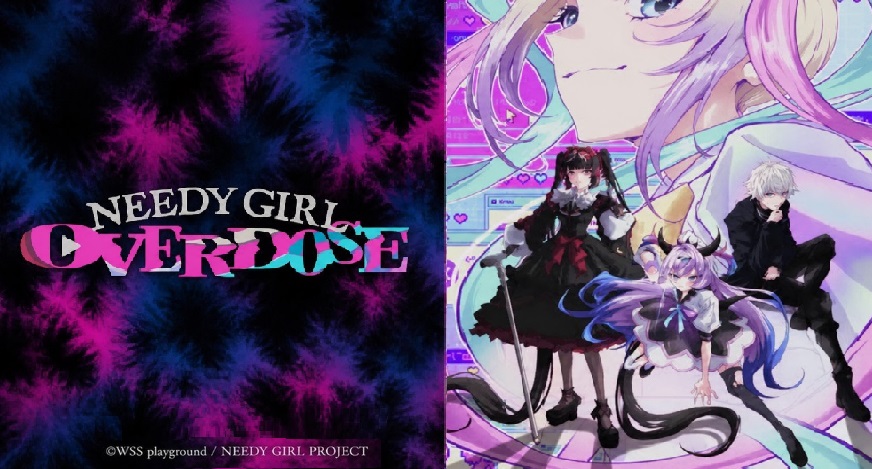
Based on the 2022 denpa-inspired visual novel Needy Streamer Overload, created by Japanese developer Xemono, written by Nyalra, and illustrated by Ohisashiburi, the story unfolds in a world where likes are currency. Every viewer is a judge, following OMGkawaiiAngel, also known as KAngel (pronounced “Kay-Angel”), as she strives to become the ultimate “Internet Angel,” all while her pastel-bright persona and energetic livestreams begin to reveal a far more complicated reality beneath the surface.
On the technical side, this anime adaptation was produced by Yostar Pictures and directed by Masaoki Nakashima, with character designs by Kenji Saikai, Akari Takei, and Kaito Shimizu, and music by Aiobahn +81, Sasuke Haraguchi, and DÉ DÉ MOUSE. The opening theme song is “Internet Angel” performed by “KAngel” (“Chōten-chan”),[45] while the ending theme song is “Levitation” performed by Tatsuya Kitani.
Entering the mind of a deeply troubled person is never an easy experience, and “Needy Girl Overdose” throws you directly into that uncomfortable space. The series explores isolation, obsession, validation, mental instability, and the darker side of internet culture through a chaotic and surreal perspective. At its best, it creates a fascinating psychological portrait of broken individuals searching for meaning and connection. At its worst, it feels like a collection of ideas desperately trying to prove how deep and unconventional it is. The anime clearly has a vision behind it, but that vision is not always consistent, making it feel like it could have benefited from a shorter runtime or a more focused adaptation.
For the casual viewer, this is not a series that can be just listened to in the background while folding laundry. It demands attention, patience, and a willingness to interpret its symbolism rather than expecting everything to be explained. The story constantly shifts among reality, metaphor, hallucination, and social commentary, creating a dreamlike experience that can leave viewers confused yet impossible to ignore. The series draws inspiration from works such as Serial Experiments Lain, Perfect Blue, and other forms of transgressive fiction, using unconventional storytelling to explore identity, loneliness, and the relationship between people and the internet. Much like SHIBOYUGI, it embraces an abstract and artsy approach that prioritizes atmosphere and interpretation, which can either feel creatively ambitious or overly pretentious depending on your perspective.
A major criticism of the adaptation is that it sometimes loses sight of what made the original Needy Streamer Overload game compelling. Instead of primarily focusing on Ame/KAngel’s personal struggles and her destructive relationship with online validation, the anime expands into broader commentary about streaming culture, influencers, and internet celebrity. Some viewers appreciate this attempt to create a new narrative, while others feel it sacrifices the emotional core of the original story. The introduction of Karamazov and the heavier emphasis on social commentary create a more ambitious direction, but the series occasionally explains its themes too directly instead of allowing viewers to naturally interpret them. At the same time, the anime’s attention to detail is undeniable, especially with its recurring use of musical and cultural references. Nearly every episode title is connected to a song, album, or piece of music, with examples like Marilyn Manson’s “Antichrist Superstar” or the song “Killer Queen” being used as actual episode titles. These choices reinforce the series’ obsession with identity, rebellion, fame, and self-destruction while adding another layer for viewers willing to dig deeper.
The strongest aspect of the anime is undoubtedly its presentation. The visual direction, animation style, and music work together to create an atmosphere unlike most modern anime. The series constantly experiments with colors, editing, imagery, and unconventional framing to reflect the unstable emotions of its characters. Even when the narrative becomes difficult to follow, the direction often succeeds at communicating feelings and ideas through visuals alone. The soundtrack is another major highlight, perfectly capturing the contrast between artificial happiness, loneliness, desperation, and the pressure of maintaining an online persona. While some production choices may divide audiences, the ambition behind the presentation is undeniable, and the voice acting, sound design, and artistic choices help make the experience memorable.
Overall, Needy Girl Overdose is an anime that will either completely resonate or polarize audiences. It is not a straightforward story designed for easy enjoyment, but rather a disturbing and experimental exploration of internet culture, mental health, identity, and the search for validation. Some viewers will see a brilliant piece of transgressive fiction filled with symbolism, references, and meaningful commentary, while others will see an unfocused and pretentious work that mistakes confusion for depth. Both reactions are understandable because this series intentionally exists in that uncomfortable middle ground. Flawed but unforgettable, it mostly succeeds in its refusal to be ordinary. And whether that makes it fascinating or frustrating depends entirely on how willing you are to engage with what it is trying to say.