Season Review: Cyberpunk: Edgerunners Season Two
OVERVIEW:
Set after the escapades of David Martinez and his crew, a truth-seeking filmmaker, a vengeful netrunner, a rebellious corporate gangster, and a retired edgerunner face new challenges in Night City.
OUR TAKE:
Since its initial release, Cyberpunk: Edgerunners has had a profound impact on all its viewers. It revitalized the falling playership of Cyberpunk 2077, inspiring players both old and new to take revenge on Adam Smasher. Years later, Rosa Walton’s “I Really Want to Stay at Your House” still causes fans to freeze up. When the series held a crossover event with the RPG Wuthering Waves, new players flocked to the video game in droves. The four years since its release and its Wuwa crossover gave time for fans’ hearts to heal, and this latest season arguably helps that process, rather than breaking ours all over again. This is because Cyberpunk: Edgerunners II is, fundamentally, a hopepunk story.
Unlike Season 1, which focused solely on David Martinez, all four main characters only ever meet once across Season 2. Instead, the season has two distinct plotlines. The main protagonist of one is Roman Carax, a kid with minimal hardware and an old-fashioned sense of filmmaking. His obsession with the truth and story leads him to D, a netrunner seeking revenge for his tribe. Their dynamic starts off amusingly, as a young, bright-eyed, and talented kid helping the moody, inexperienced netrunner navigate Night City. Although this could be the point, halfway through he becomes less of a character than a stand-in for the audience to see D’s story unfold.
On the flipside, D quickly establishes himself as a narrow-minded avenger that grows manic once the digital construct Capri grants him power. Her installation quickly changes him from sparing his targets to killing and even publicly torturing them. This culminates in the publicized torture and murder of Arasaka executives, further encouraged by Yupi. A prime example of revenge going too far is when D led a group to an executive’s home. Though he knows nothing, the edgerunners burn and loot the place, even murdering a defenseless woman in the process.
His conversation with Roman, if a little on the nose, makes it clear revenge does not serve justice. It only serves self-satisfaction, or in D’s case, a desperate attempt to soothe his survivor’s guilt. This feeling only worsens when he learns that not only did the Snake Nation target him, but that the Arasaka executive responsible was already killed. This culminates in the listless instigation of a violent, all-encompassing riot across Night City, spearheaded by Yupi. In the end, Omi snaps him out of it after insisting he should’ve done what he wanted to. He ultimately follows that belief when he re-retrieves Capri and presumably dies with her. It’s not a new take on revenge being bad, but effective all the same.
The second most important pairing is Weak Kingsley, a veteran edgerunner downgrading his cyberware, and his alleged daughter Talia, who has constant operations to replace her organic flesh. The threat of cyberpsychosis hangs especially heavy in their story, after being underlined so much in Season 1. It showed how frighteningly easy it is to succumb to violence or forget oneself entirely. It’s what triggers relief when Weak’s chrome is downgraded. Likewise, it’s why he insists to Talia not to get any more installations so strongly.
Theirs is a story about humanity, about stepping away from the machines they are becoming, and developing a father-daughter relationship. It’s a story about life and living, as after retiring, Weak’s will to live is revitalized after discovering Talia. Her constant modifications and wanting to die beautifully even touch on a theme of body image and self-acceptance. In the end, it’s also that relationship that saves Talia from completely merging with Capri.
A character that doesn’t make as much sense, however, is Capri. While she works reasonably as a MacGuffin for the series, her motivation is all over the place. When D first tests her abilities, she fed off his addiction to power. Meanwhile with Talia, her feelings of objectification by her father as a test subject causes her to rampage. The idea that Capri’s personality changes based on whoever she possesses, as D implies, is certainly better than doing it “for the lulz.” Other questions surrounding the construct include how she knew Talia was a better host than D—possibly by checking her medical records and implants—or how she managed to detach her “soul” from her power.
Cyberpunk: Edgerunners II tells a different story from its predecessor, which is reflected best in its soundtrack. The opening is the Cure’s “10:15 Saturday Night,” which is more chill both in song choice and animation than Season 1. It’s not a particularly punchy opening or an expected introduction into Night City, but effective at establishing the overall mood. Similarly, the ending credits are more hopeful, featuring Petite Meller and Oslo Green’s slow pop song “Watson” and Roman’s silhouette stumbling but persevering all the while. Aside from those two, the only other noteworthy songs include Rico Nasty’s “You Can’t Run From Me” and Corbin’s “Worth It,” but none live up to “I Really Want to Stay At Your House” or “This Fffire.” Still, the other songs pulled from the video game or made for the show successfully bring Night City to life.
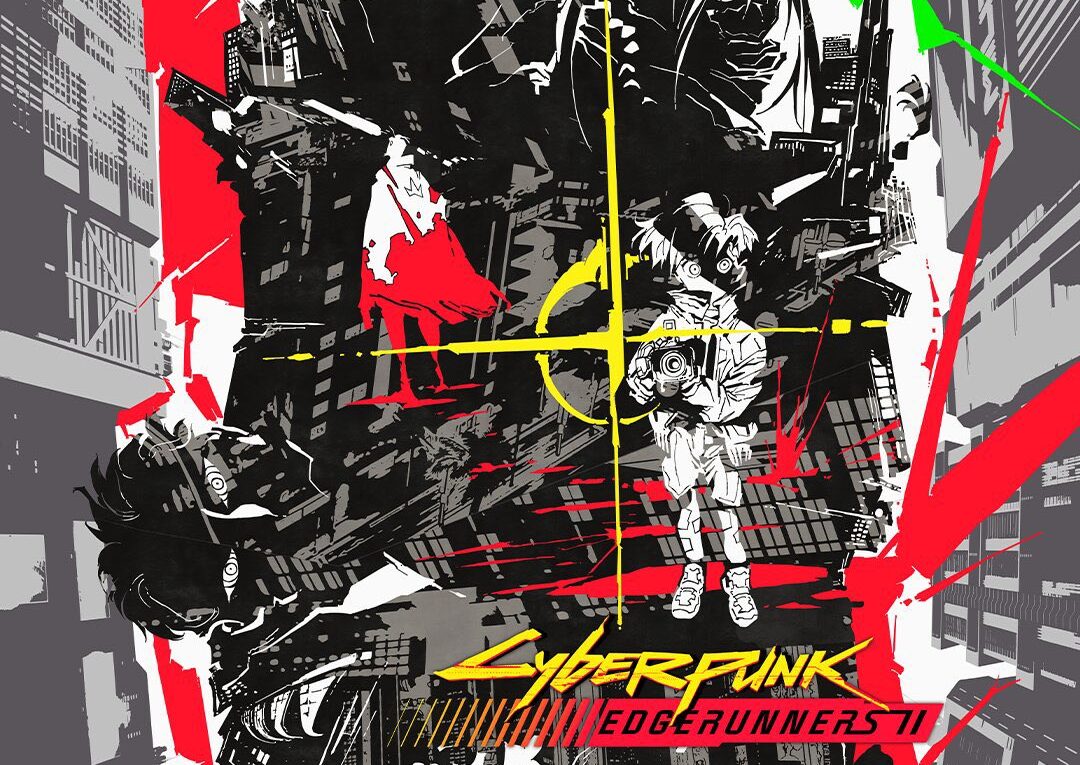
By the story’s nature, there are slightly less fights or gory visual spectacles than Season 1. However, the fast-paced animation, which lingers on the violence long enough to never forget, remains the same. The animation for Season 2 takes even more from anime than the previous, featuring chibi-like designs typical of visual gags. More extreme examples for moody characters such as D include dark shading, or the fish-eye lens zoom-in on their faces. There are also changes to other art styles and color schemes, such as in D’s sharper, angular dream sequences, or Talia’s black-and-white flashbacks with only a few other colors in such scenes.
While Cyberpunk: Edgerunners II is enjoyable, its experience isn’t as airtight as Season 1. One of my concerns, despite the show leaving the rules for cyberpsychosis unclear, is how its onset for Weak and Talia seem gentler. For David and Maine, the condition emerged abruptly after installing too much chrome, marked by violent lapses. Meanwhile, Weak never required any checkups or immunosuppressants after downgrading, and MedCenter treated and diagnosed Talia early before psychosis. Admittedly, none of the previous characters had a Trauma Team Platinum package nor access to MedCenter. Another nitpick is how Yupi’s final flashback feels like they were trying too hard to give too much character to everybody. This works against some of the more abrupt deaths that worked in Season 1, such as Pilar or Julio.
Speaking as a fan who hasn’t fully experienced the game, I don’t hate the idea of a happy ending in Night City. I don’t even consider this ending happy, since the higher-ups in the corpo world remain in power. Still, the season ends on an uplifting note where our heroes resolve to find happiness. And perhaps that’s the message that we need to hear now more than ever.
Cyberpunk: Edgerunners II is streaming now on Netflix.