English Dub Season Review: Thunder 3 Season One
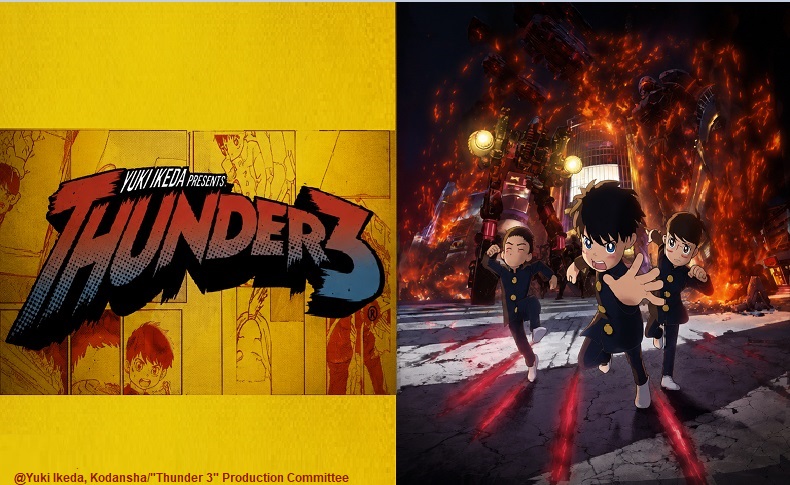
Based on the Japanese manga by Hiroya Oku (creator of GANTZ), under the pen name Yuki Ikeda, this stylized sci-fi anime follows the “Small Three”: Pyontaro, Hiroshi, and Tsubame, as they accidentally open a portal to a parallel world using a mysterious DVD. When Pyontaro’s younger sister, Futaba, and their dog are pulled through and kidnapped by aliens, the boys discover their cartoonish bodies possess strange powers in this hyper-realistic world. Now, they must join forces with its human survivors and battle the extraterrestrial threats to rescue Futaba.
On the technical side, this anime television series adaptation is produced by Unend and directed by Keisuke Ide, with chief direction by Hiroyuki Seshita, series composition and screenplays by Hiroshi Seko, character designs by Junko Yamanaka and Yūki Moriyama, with original character design concepts by Naoyuki Onda, and music composed by Frédéric Chateau and Akiyuki Tateyama. The opening theme is “Thunderbolt,” performed by Yuuri, and the ending theme is “Shururerira,” performed by Otoha.
Thunder 3 initially presents itself as a fairly ordinary slice-of-life comedy centered on Pyontaro Tezuka, an average middle schooler living with his family in Japan. Alongside his cheerful best friend Hiroshi Ochanomizu and the eccentric Tsubame Azuma, Pyontaro makes up part of the trio known as the “Small 3,” three students who generally fly under the radar at school. Their mundane routine takes an unexpected turn when their teacher, Doc, lends them an expensive video game that supposedly connects to a parallel universe. Before long, Pyontaro, his friends, and his little sister Futaba find themselves caught up in a bizarre sci-fi adventure involving another world, strange technology, and an alien threat. It’s an unusual premise that wastes little time showing there’s considerably more going on beneath the surface.
As a concept, there’s a lot to appreciate here. The sudden shift from goofy school comedy to science-fiction adventure gives the story an unpredictable edge, while the contrast between the characters’ ordinary lives and the bizarre world they encounter creates an intriguing foundation. The relationship between Pyontaro and Futaba also provides an emotional center amid all the chaos, while the mixture of different genres and visual styles gives the series a distinctive identity. There’s clearly an ambitious idea underneath everything, and when the show leans into its strange sci-fi premise, it can be genuinely entertaining. Unfortunately, that potential becomes increasingly difficult to appreciate once the story settles into its twelve-episode structure.
The biggest problem is the pacing, which becomes painfully slow and frequently makes the story feel like a much shorter adventure stretched far beyond what it needs to be. Episodes spend excessive amounts of time recapping information we already know, characters stare into space or slowly walk around without meaningful dialogue, and seemingly simple developments are dragged out for far too long. The main cast can also feel strangely sidelined despite being the most interesting part of the premise, while several side stories receive far more attention than they can reasonably sustain. The result is an anime where entire stretches can pass without anything substantial happening, creating the frustrating impression that the story is constantly stalling instead of progressing.
In terms of sounds & visuals, the distinctive cel-shaded art style gives the show the appearance of stepping straight into a stylized video game, with a look reminiscent of games like No More Heroes, Jet Set Radio, and Viewtiful Joe, while the highly detailed environments of the alternate world create a striking contrast between the two realities. There are some genuinely impressive backgrounds, mech designs, and hand-drawn moments, but the CG can also look awkward and under-polished. The voice acting and music generally provide some needed personality, yet the direction often allows scenes to linger far longer than necessary, further amplifying the pacing problems. Interestingly, it was recently revealed that Hiroya Oku, the creator of “GANTZ,” was actually behind the manga under the pen name Yuki Ikeda, which makes the series’ sci-fi influences and stylistic similarities all the more interesting.
Overall, this was a frustrating case of a promising concept that never quite reaches its potential. The series has a memorable visual identity, an unusual premise, and enough interesting ideas to make its weaker moments feel especially disappointing. With a second season announced for 2027, there’s still room for it to improve and give those ideas the focus they deserve. For now, though, it leaves the impression of a story that had something genuinely special underneath it, but never quite figured out how to bring it together.