English Dub Season Review: Sparks of Tomorrow Season One
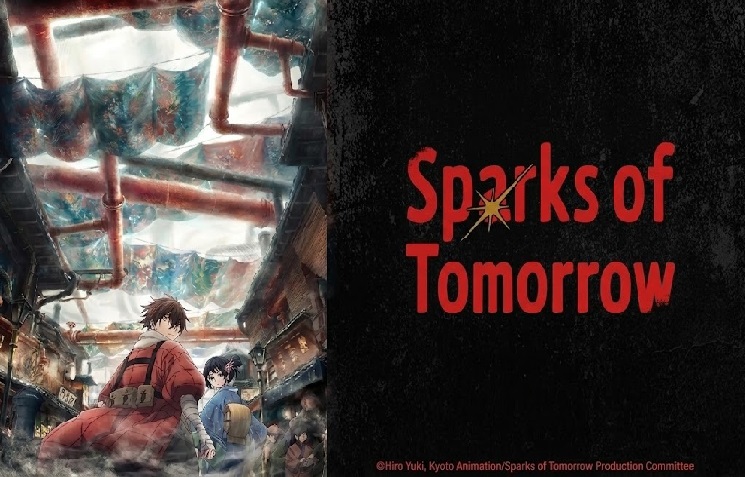
Based on the Japanese light novel by Hiro Yūki and illustrated by Kazumi Ikeda, the story takes place in an alternate 1907 where steam power dominates technological progress; devout girl Inako Momokawa crosses paths with Kihachi Sakamoto, a rebellious young man who lost faith after his older brother Seiroku disappeared. When Inako faces a forced marriage, the two set out to find Seiroku’s lost “Electrical Catalog,” a collection of ideas envisioning the electric future they once dreamed of. Along the way, they uncover its secrets while confronting their pasts and searching for a better future.
On the technical side, this 12-episode anime series was produced and animated by Kyoto Animation and directed by Minoru Ōta, with Tatsuhiko Urahata handling series composition, Kohei Okamura designing the characters and serving as chief animation director, Takaaki Suzuki overseeing the world-building, and Hitomi Koto composing the music. The series features two theme songs, with “Eureka Evrika” by Luna Goami serving as the opening theme and “Soarin’” by Ginger Root serving as the ending theme, while Netflix handles global streaming.
Set in an alternate 1907 Kyoto where steam power dominates technological progress, Sparks of Tomorrow follows Kihachi Sakamoto and Inako Momokawa as they pursue futures that defy the expectations placed upon them. Kihachi’s belief in an approaching “Age of Electricity” leads him to search for his missing brother Seiroku’s Electrical Catalog, while Inako struggles against a forced marriage and the limitations imposed by her family. Their meeting gives both characters the courage to challenge their circumstances, creating an engaging foundation built around ambition, perseverance, and the promise of technological change.
Kihachi and Inako remain the series’ most compelling characters. Kihachi’s intelligence, stubbornness, and occasional arrogance are balanced by his loyalty and determination, while Inako gradually grows from a reserved young woman into someone more confident and willing to stand up for herself and others. Their contrasting personalities complement one another, and their growing bond gives the story much of its emotional appeal. Rather than simply serving as companions, they push each other to reconsider what they are capable of and what kind of future they want.
Where the series falters is in its execution. Its alternate-history setting presents an interesting opportunity to explore the social consequences of a world caught between steam and electricity, yet the broader implications are rarely given enough attention. The narrative also becomes uneven as it progresses, with certain plot threads receiving more emphasis than they warrant while other ideas are left underdeveloped. There are still plenty of imaginative inventions, entertaining situations, and emotional moments, but the storytelling does not always maintain the same focus or momentum established at the beginning.
In terms of sounds and visuals, the show delivers in spades, with Studio Kyo-Ani (Kyoto Animation) bringing its alternate-history Kyoto to life through gorgeous backgrounds, atmospheric smog, expressive character animation, and a distinctive steampunk aesthetic. The character acting is especially strong, allowing dramatic scenes and comedic moments to transition naturally without feeling out of place. The music complements the setting effectively, while the opening and ending themes further reinforce the series’ distinctive identity. Even when the narrative loses its footing, the production remains one of the show’s greatest strengths.
Overall, Sparks of Tomorrow is an attractive and occasionally engaging series that is held back more by its storytelling than its presentation. Kihachi and Inako are likable leads, their relationship provides genuine warmth, and the setting offers enough creative ideas to keep things interesting. As of the time of writing, it also remains uncertain whether the series will receive a second season. There are the bones of a good story here, but the finished product feels like a promising idea that was never given enough room to fully develop. For all its shortcomings, however, its memorable characters, striking world, and polished presentation make it worth experiencing.