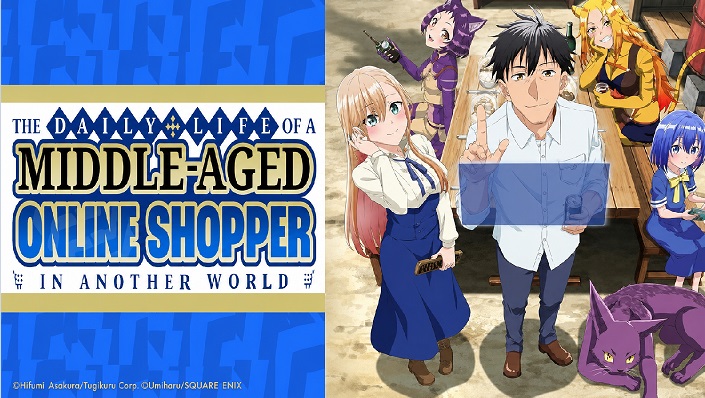
English Dub Season Review: The Daily Life of a Middle-Aged Online Shopper in Another World Season One
Based on the Japanese light novel series written by Hifumi Asakura and illustrated by Yamakawa, the story follows Kenichi Hamada, a 38-year-old dude who is mysteriously transported to another world by a god. There, he discovers that he not only has a magical item box and can read his stats through magical touchscreen text boxes, but can also still access Earth’s internet and his favorite online shopping service, Shangri-La. With the ability to purchase modern goods and sell them to the locals, Kenichi quickly makes a living as a merchant, but rather than chasing wealth or fame, all he wants is a quiet life away from the hassles of civilization. After settling in a forest cabin, however, monsters, unexpected visitors, and rumors of other people from Earth threaten to disrupt his peaceful existence. And so begins the leisurely otherworldly life of a middle-aged man who wants to live off the power of one-click shopping and, essentially, the power of Jeff Bezos.
On the technical side, this Anime adaptation was produced by East Fish Studio and directed by Yoshihide Yuuzumi, with scripts overseen by Masanao Akahoshi, character designs by Hiroyuki Moriguchi, and music composed by Kujira Yumemi. The opening theme song is “Give&Take” by Asaka, while the ending theme song is “Love Craft” by Kiminone.
At its core, the show itself has a similar setup to Campfire Cooking in Another World, with Kenichi finding himself in a medieval fantasy setting full of magic & monsters where he soon discovers that his modern conveniences haven’t been left behind. Along with having a magical item box and being able to view his stats through floating, touchscreen-like magical displays, he somehow retains access to Earth’s internet and, more importantly, his favorite online shopping service, “Shangri-La.” The biggest difference is that, unlike the aforementioned Campfire Cooking, Kenichi can occasionally purchase vehicles & certain weapons and doesn’t have any talking otherworldly animal companions traveling alongside him (unless you count the Cat People he encounters in later storylines). Using Shangri-La, he purchases goods from Japan and resells them for a profit, turning ordinary conveniences into valuable commodities. Rather than chasing adventure or aspiring to become a legendary hero, Kenichi simply wants enough money to live comfortably, and watching him establish himself as a merchant while introducing modern products to this world is easily one of the series’ biggest strengths.
Kenichi is also a welcome departure from the usual teenage protagonist that dominates the isekai genre. As a middle-aged man, he tends to think before acting and understands that gaining too much power or notoriety could bring more trouble than it’s worth. His ambitions are refreshingly modest, as he has no desire to become famous, overthrow kingdoms, or save the world unless circumstances force his hand. He simply wants to make a decent living, stay out of trouble, and enjoy a peaceful existence. That laid-back mindset fits the slower pace particularly well, making his everyday experiences feel more engaging than another predictable hero’s journey.
Where the series starts to stumble is with its harem and fan service moments. Kenichi attracting romantic attention can be amusing at times, but the story occasionally seems determined to insert these elements into a premise that doesn’t need them. I would have preferred more focus on his business, the possibilities offered by Shangri-La, and his attempts to build the comfortable life he originally wanted. The constant parade of women becoming interested in him can pull attention away from the economic and world-building aspects that make the series stand out, while some of the fan service feels more obligatory than worthwhile. Whenever the story shifts focus toward another admirer, it loses some of the charm found in its more original ideas.
The animation is easily the weakest part of the production, with limited movement, distant shots, and inconsistent character art occasionally making scenes feel closer to a slideshow than a polished anime. The bright color palette and some of the creature designs are also hit-or-miss, although everything remains serviceable. Viewers will also want to keep the subtitles on, since Kenichi’s various RPG-style stats and website purchase windows appear throughout the show, along with occasional text at the bottom of the screen displaying the prices of specific objects he purchases or encounters. The series does occasionally take a darker turn with criminals, violence, and death, providing some welcome contrast to its otherwise relaxed atmosphere, though censorship often keeps these moments from becoming particularly graphic through shadows and strategically placed camera angles. The opening also oversells the action, portraying Kenichi alongside his future companions and even heavy machinery that barely factors into the actual story. Thankfully, the music fits the laid-back atmosphere well, even if it isn’t especially memorable.
Overall, while this show was a bit flawed, it remained an enjoyable isekai that succeeds most when it embraces its unusual premise. Kenichi’s merchant lifestyle, the absurd possibilities of Shangri-La, and the slower approach to fantasy give it enough personality to rise above the genre’s more generic offerings. However, the harem elements, unnecessary fan service, uneven animation, and occasional storytelling conveniences keep it from reaching its full potential, but there’s still plenty to enjoy if you’re after something laid-back and quirky. Kenichi doesn’t need to save the world; he just needs to make enough money to live the good life, essentially turning a fantasy/adventure story into Jeff Bezos’ personal business venture.