Review: President Curtis “Pilot”
OVERVIEW (SPOILERS)
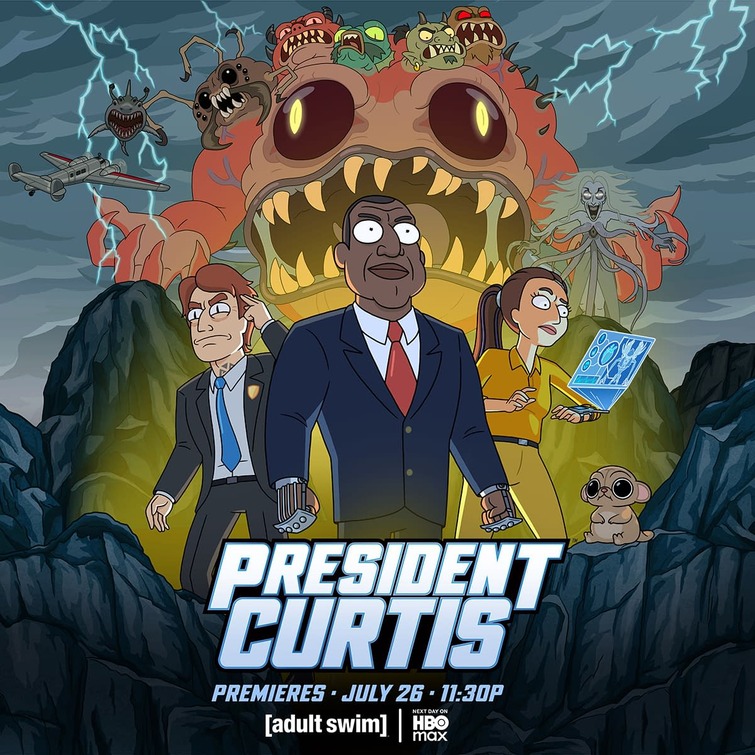
President Andre Curtis, with the help of Cyborg Chief of Staff Roe Banks and half-Leprachaun Special Agent Francis O’Doyle, faces blackmail from the CIA unless he turns over the “real” moonlanding footage, uncovering more dark and shameful secrets in the nation’s past.
OUR TAKE
Wait, this wasn’t a prank? Apparently not as we have our first official Rick and Morty spin-off show (not counting miniseries like The Anime) and it’s focusing on the series’ eternal Commander-in-Chief, President Andre Curtis. Presumably the one that we’ve been familiar with Season 6 when the Smiths relocated to the “Parmesan Dimension” and not the one we first met in Season 2 and then made sporadic appearances from then to Season 5, but it could also be a different one entirely to fully separate it from the main Rick and Morty show! Regardless, President Curtis, previously just called “The President” has often been portrayed as one of the few characters who could rival Rick in terms of resources and ego, leading to several escalating conflicts between them that also gave whoever was writing them a chance to take some shots at American politics in general, and not just contemporary things but the many screwed up real life the US Government has done across its couple centuries of existence and then ratchet them up even higher for the sake of comedy. Curtis made for a solid recurring character in the show, whether as an antagonist or reluctant ally, made better by the velvety tones of voice acting legend Keith David.
But does that mean he can carry a show of his own almost entirely removed from Rick and Morty? Well, apparently someone at Adult Swim thought so and so here we are. I’ve seen quite a lot of spin-offs of popular shows and I’ve noticed a few notable traits that help identify which ones manage to land and make themselves feel necessary and distinct while feeling consistent within the brand they came from. There are the “Darker and Edgier” shows like Torchwood and Angel that can get more adult and morally compromised than their sister shows that tend to be more light hearted and fun. Conversely, there’s the more comedic and silly shows like any given “chibi” spin-off of a serious anime that just gives the characters chances to riff while removing the dramatic stakes. And then there’s shows which just want to focus on a different point in time or less explored area of the main show’s world, like going from Star Trek TNG to DS9, or from Game of Thrones to the two ongoing shows, House of the Dragon or A Knight of the Seven Kingdoms. Those are just a few examples and types and it’s not like this is an exact science, but it’s all to say that there are a lot of ways to make a spin-off work, and probably just as many ways for it to not work.
But the question for this review is how did THIS spin-off do with its pilot? Well, first off, what stands out most about it is that it is a pilot written by someone who DID break writing a pilot down to a nearly exact science…because it was. Dan Harmon, co-creator of Rick and Morty, co-wrote this pilot, and if you’ve looked up any of his videos or writings about writing, specifically writing a pilot, you can definitely see boxes being checked as the episode goes on. Though what also becomes clear is that this episode is more about the arc of Roe Banks, and her learning to work with Curtis and O’Doyle, which she of course does by the end. Unsurprisingly, the plot makes use of existing conspiracy theories, in this case the moon landing, to give us a taste of what future episodes will be like. Along with the obligatory “passing the torch/keys” scene from Rick and Morty to Curtis which itself feels like the writers know that the audience knows it will feel obligatory. And they start introducing more personal details about Curtis, like the fact that he’s divorced and still working through it, to provide teases for potential future stories. What I wonder is, since Rick and Morty covers basically the entire multiverse and has a pretty all-encompassing tone already, what will a show centering on mostly one country with a very similar tone do to not feel redundant by the end of its first season? I suppose we’ll just have to keep watching the remaining nine episodes of it to find out.