English Dub Season Review: My Gift Lvl 9999 Unlimited Gacha: Backstabbed in a Backwater Dungeon, I’m Out for Revenge! Season One
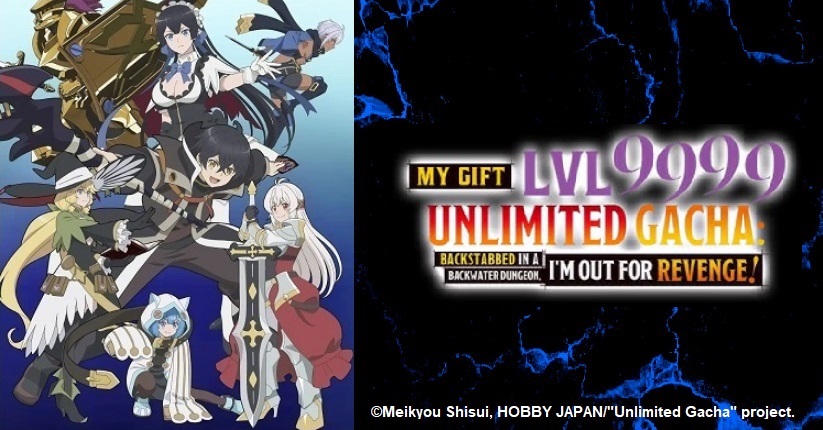
Based on the Japanese light novel series by Shisui Meikyō and illustrated by tef, the story is set in a fantasy, medieval world where humans are treated as a lower class, often abused or enslaved by other races. It follows Light, a human adventurer and former member of the “Concord of the Tribes”, a group dedicated to fighting discrimination against humans. After being betrayed and left to die in the perilous Abyss dungeon by his so-called “comrades”, Light narrowly survives and discovers a magical skill called the Unlimited Gacha. While it initially produces only junk, it unexpectedly summons Mei, a formidable Level 9999 fighter in a maid outfit. Over the next three years, Light builds his own kingdom deep within the dungeon, summoning a loyal cadre of powerful Level 9999 warriors, and becomes an Overlord himself, preparing to rise to the surface and exact revenge on those who betrayed him.
On the technical side, this adaptation was produced by J.C.Staff and directed by Katsushi Sakurabi, with series composition and scripts written by Hiroshi Ōnogi, characters designed by Yukie Suzuki, and music composed by Ryo Takahashi. The opening theme song is “Sen Yori Kaminari ya, Sarariya Takaki”, performed by Tei, while the ending theme song is “Shirogarasu”, performed by Nowlu.
At its core, the series follows Light, a human teenager born into a world where humans are universally treated as the weakest race and subjected to relentless discrimination. From the outset, the show frames its story around systemic cruelty and inevitable betrayal, positioning Light as disposable by design. While this setup is effective at generating sympathy, the worldbuilding leans heavily on exaggeration rather than explanation. The reason for humanity’s total social collapse is never fully articulated, leaving lingering questions about how human societies, guild roles, or adventuring paths even function. The emotional hook is strong, but the logic holding the setting together is noticeably thin.
Light is introduced as kind-hearted and painfully naïve, invited into a multi-racial party despite the prejudice surrounding his existence. That fragile trust collapses when the party betrays him deep inside a dungeon, abandoning him once he’s deemed useless. A teleport trap saves his life, casting him into the dungeon’s deepest, mana-saturated layer, where his skill, Unlimited Gacha, finally reveals its true nature. What was once mocked as worthless becomes catastrophically powerful under the right conditions. The moment lands, but the transition is rushed, due to a 3-year time skip that completely breezes through any meaningful struggles or hardships that greatly reduce what should’ve been a gradual rise into an abrupt power spike.
Once reborn through betrayal, the series fully commits to its revenge story, albeit with a slight stumble. As Light summons powerful allies through his gacha ability, despite each of them having colorful personalities, they are all bound by their unwavering loyalty to him, and establish an underground kingdom with hierarchy, laws, and order. His use of a separate alias while exploring the world, gathering information, and building influence strongly echoes the Anime series “Overlord”, particularly in how the narrative mirrors the dynamic of a central figure operating from the shadows while their respective colorful & diverse subordinates expand their reach. The comparison isn’t subtle, but it works in the show’s favor, giving structure to Light’s rise and reinforcing his shift from victim to calculated power player. This methodical setup strengthens the revenge arc, even if it comes at the cost of tension due to guaranteed loyalty and limited internal conflict.
Visually, the production does much of the heavy lifting. Animation during confrontations is sharp, expressive, and fluid, with non-human character designs receiving noticeably more attention and creativity than their human counterparts. Action scenes are clean and readable, and the series does not shy away from bloodshed, reinforcing its bleak tone, even if parts of the story require subtitles since this show’s universe has its own unique writing style. The soundtrack supports both the tension and quieter moments effectively, while the opening and ending themes complement the show’s aggressive atmosphere without overstaying their welcome.
Overall, this is an unapologetically edgy revenge fantasy that prioritizes payoff, catharsis, and spectacle over polish, nuance, or world-building. Light’s rise from discarded weakling to dominant force is satisfying to watch, even if the story skips over meaningful struggle, relies on rushed progression, and leans on guaranteed loyalty to reduce tension. The series commits fully to its premise, showcasing calculated retaliation, devoted allies, and morally reprehensible antagonists, making every act of retribution land with force. While some narrative shortcuts and shallow worldbuilding occasionally undermine immersion, the show delivers exactly what it promises: a direct, brutal, no-compromise revenge story that is engaging, entertaining, and relentlessly satisfying for viewers craving unflinching vengeance. If Season 2 ever becomes a reality, it would be fascinating to see how the story expands and explores Light’s world even further.