
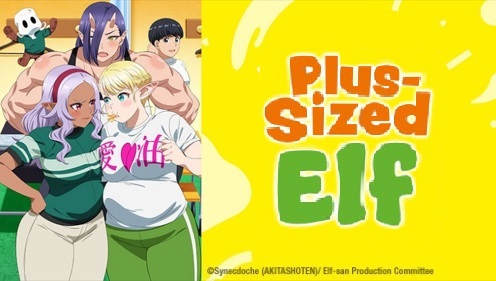
English Dub Season Review: Plus-Sized Elf Season One
Based on the Japanese manga series written and illustrated by Synecdoche. The story follows Tomoatsu Naoe, an osteopathic massage therapist, who meets a new client. She is Elfuda, an elf from another world who gained an excessive amount of weight during her stay on Earth by eating French fries, who needs his help shedding pounds so she can return through the portal that leads her home, which, for some strange reason, hinges on body weight and Mana. As Tomoatsu assists with Elfuda’s weight loss, many other overweight mythical creatures come seeking his help…
On a technical side, this anime adaptation was produced by Elias and directed by Toshikatsu Tokoro, with scripts written by Yuki Takabayashi, characters designed by Katsuyuki Sato, and music composed by Cher Watanabe. The opening theme song is “Fried☆Pride” performed by Real Akiba Boyz, while the ending theme song is “Let’s Diet Together!” performed by mostly the female Japanese cast of the series.
Plus-Sized Elf is a curious entry in the world of anime, primarily because it openly embraces a niche not often represented in the medium. At its core, it’s a comedic ecchi series centered on fantasy women from another world who’ve grown fond of modern luxuries—particularly junk food—and gained weight. From a conceptual standpoint, it stands out as one of the few shows to center a plus-sized lead unapologetically. Unfortunately, while the premise shows promise, the execution often falls short. The opening theme, in particular, is jarring and uncomfortable; the song and accompanying dance sequence come off more mocking than playful, leaving some viewers with the impression that it’s shaming the characters rather than celebrating them.
The narrative is practically nonexistent, acting more as a series of loosely connected skits than a continuous plot. The protagonist, a massage therapist named Naoe, encounters different overweight monster girls and attempts to help them slim down. While this creates opportunities for lighthearted banter and absurd comedic setups, there’s no meaningful character development or world-building to anchor the story. Many characters are introduced with potential but quickly fade into the background, and rarely return in random follow-up episodes. The humor leans heavily into exaggerated personalities and recurring gags centered on body image, food addiction, and exercise, which may get repetitive or shallow over time, especially since Hidive went the extra mile to have uncensored nudity, yet it’s often used as a punchline to a wacky joke.
Despite its flaws, the show manages to avoid feeling mean-spirited, which could’ve easily happened with this type of premise. There’s a sincerity beneath the surface, especially in how it portrays body positivity within the context of its fantasy world. Rather than ridiculing the characters, the anime often treats them with affection and quirky charm, as exemplified by Naoe being both a sympathetic instructor and a gentle soul who never gives up on these otherworldly women and simply wants to help them with their struggles without judgment. Still, some jokes miss the mark, and the show would benefit from more thoughtful writing that explored broader themes like self-worth, health, and confidence, rather than focusing solely on dieting as a goal. When the show flirts with deeper moments like showing the emotional struggles of the girls adjusting to human society it teases a richer potential that it never fully explores.
Visually, the series struggles. The animation ranges from serviceable to clumsy, with frequent off-model shots and an opening sequence that’s awkward enough to be a distraction. It’s a low-budget production, which shows in the minimal motion, stiff choreography, and flat compositions. The ending stills are often more polished than the actual animation, offering glimpses of what the series could have looked like with better resources. The art style mimics the manga decently but loses a lot of the softness and expressiveness that made the original material appealing. Musically, the upbeat opener and breezy ending theme underscore the light comedy, while in-episode cues serve mostly to highlight awkward or steamy moments without striving for memorable melodies. All told, the audio-visual package is serviceable for twelve-minute shorts, but it rarely impresses beyond its core gimmick.
Overall, Plus-Sized Elf is a deeply flawed but occasionally enjoyable series that unapologetically caters to a specific audience. If you’re someone who appreciates curvier character designs and doesn’t mind a paper-thin plot, there’s entertainment to be found in the light ecchi antics and offbeat humor. However, for general anime fans or anyone seeking substance, meaningful storytelling, or polished animation, this probably won’t hit the mark. The series knows exactly what it wants to be: a silly, skin-deep comedy filled with jiggling monster girls, and never pretends to be more than that. If that’s what you’re after, it delivers just enough, but those hoping for something deeper or more respectful in tone may find themselves disappointed. Still, as one of the few anime that dares to center plus-sized characters with some degree of affection, it earns points for novelty even if it stumbles in the execution.









"There are also other characters that come and go (also owned by the Warner Bros. Discovery conglomerate media company)."
Huh. Is that just referring to other characters from the show itself, or is this implying that the new season is going to have cameos from other WBD IPs