English Dub Season Review: Aoashi Season One
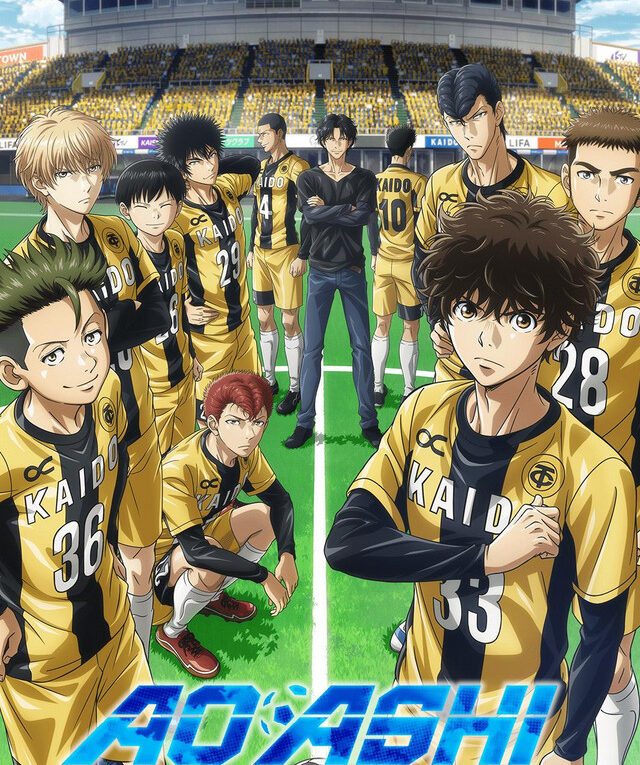
Based on the Japanese manga series written and illustrated by Yūgo Kobayashi, Aoashi follows Ashito Aoi, a talented yet hot-headed and self-centered soccer player in his third year of middle school in Ehime Prefecture. As the star of his local soccer team, Ashito relies on his unpredictable moves and individual skill to carry his teammates through an important tournament, but his temper gets the better of him when a confrontation with an opponent leads to a violent outburst and his removal from the game. Following his team’s elimination, Ashito is left devastated until Tatsuya Fukuda, a coach overseeing a youth development program affiliated with a leading J.League club, recognizes his raw potential and invites him to try out for his team in Tokyo. In an unfamiliar environment surrounded by talented players, Ashito must overcome his shortcomings, learn the importance of teamwork, and refine his abilities if he hopes to pursue his dream of becoming a professional soccer player.
On the technical side, the first season of Aoashi was produced by Production I.G and directed by Akira Satō, with scripts written by Masahiro Yokotani, character designs by Manabu Nakatake, Toshie Kawamura, Asuka Yamaguchi, and Saki Hasegawa, and music composed by Masaru Yokoyama. The opening theme song is “Mushin Hakusū,” performed by Alexandros, while the ending theme song is “Blue Diary,” performed by Rinne. The second opening theme is “Presence,” performed by Superfly, while the second ending theme is “Color Lily no Koibumi,” performed by Kami wa Saikoro wo Furanai.
Ao Ashi is an engaging sports anime that follows Ashito Aoi, a passionate but inexperienced soccer player determined to become a professional. What begins as a familiar underdog story develops into a grounded exploration of soccer, emphasizing tactics, positioning, teamwork, and the challenges of competing at an elite youth academy. With its compelling matches and cliffhangers, the series makes for an entertaining binge-watch, even if some episodes take their time getting to the action.
One of the anime’s strongest aspects is its character development, particularly Ashito’s gradual transformation from an overconfident forward into a player who better understands his strengths and responsibilities. His struggles, mistakes, and difficult adjustments make his progress feel earned, while the supporting cast adds depth through their own ambitions and rivalries. The relationships between players and coaches also contribute to the story, although certain supporting characters could have benefited from more attention.
Despite its strengths, the show itself has several shortcomings that occasionally undermine the experience. Ashito’s constant shouting and immature behavior can become irritating, while lengthy monologues sometimes explain too much instead of allowing the action to speak for itself. Some dramatic moments feel exaggerated, and much like a CW Superhero show, the romantic subplots add nothing to the narrative. Additionally, certain matches could have featured more dynamic action and clearer explanations of what makes particular plays impressive.
When it comes to the animation and music, Production I.G delivers a clean art style that captures the characters’ expressions and supports the series’ grounded atmosphere. However, some soccer sequences lack fluidity and could have been more visually dynamic. The soundtrack and sound effects effectively build tension during important matches, while the opening and ending themes complement the overall tone. The combination of music and visuals is especially effective during emotional scenes, helping give Ashito’s personal struggles greater impact.
Overall, Ao Ashi is a rewarding sports anime that balances tactical soccer, personal growth, and emotional storytelling. Although its pacing, occasional overdramatic moments, and Ashito’s personality can be frustrating, the series succeeds in making his development satisfying to follow. Its emphasis on teamwork, perseverance, and learning from failure distinguishes it from more exaggerated sports anime, and with the recent news of a 2nd season, we know Ashito’s antics are far from over.