English Dub Season Review: Given Season One
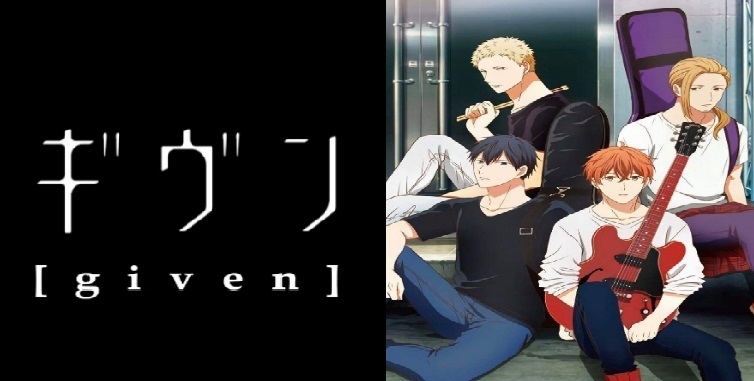
Based on the Japanese manga series written and illustrated by Natsuki Kizu. The story begins with Mafuyu Satou who while tightly clutching his Gibson guitar, steps out of his dark apartment to begin another day of his high school life. While taking a nap in a quiet spot on the gymnasium staircase, he has a chance encounter with fellow student Ritsuka Uenoyama, who berates him for letting his guitar’s strings rust and break. Noticing Uenoyama’s knowledge of the instrument, Satou pleads for him to fix it and teach him how to play. Uenoyama eventually agrees and invites him to sit in on a jam session with his two band mates: bassist Haruki Nakayama and drummer Akihiko Kaji.
Satou’s voice is strikingly beautiful, filling Uenoyama with the determination to make Satou the lead singer of the band. Though reticent at first, Satou takes the offer after an emotional meeting with an old friend. With the support of his new friends, Satou must not only learn how to play guitar but also come to terms with the mysterious circumstances that led him to be its owner.
On the technical side, This Anime adaptation was produced by Lerche with the primary production staff consisting of Hikaru Yamaguchi as director, Yuniko Ayana as a scriptwriter, and Mina Osawa as character designer, and Michiru as score composer. The series’ four original songs — opening theme “Kizuato”, closing theme “Marutsuke”, and original songs “Session” and “A Winter Story” are composed and performed by Centimillimental, with additional vocals from Mafuyu voice actor Shōgo Yano on “Marutsuke” and “Fuyu no hanashi”. As a bonus the majority of the 11 episode titles in Given are references to British alternative rock songs, Ritsuka’s favorite genre of music, however, episode 9 is titled after the original song performed in the episode.
I may not be the right audience for this due to this show being under a subgenre of anime called “Boys Love”. But at the very least, it manages to accomplish its niche romance story without being overly graphic or sexual and doesn’t write gay male characters as grotesque, overly effeminate, stereotypes that most TV shows and wacky romcoms were often guilty of doing in the past (I’m looking at you Happy Madison!). The animation is colorful and although it can be clunky at times, at other times, they can achieve some interesting and engaging shots, from often unused angles, and this is further exemplified particularly in the first episode.
The heart of Given is a story about two young musicians, one just starting his real journey into music, and the other trying to rekindle the passion he lost through the disillusionment the teenage years can bring. Ueenoyama, has lost his passion for music and finds it rekindled by Sato’s genuine Naive desire to learn to play the guitar and become a musician. At its core, the characters and the emotions they experienced were portrayed accurately and realistically, and the conflict & drama wasn’t doesn’t feel forced or inserted for the sake of pointless conflict like those bullshit “third act breakup” scenes you find in most formulaic & cliche romantic comedies. But instead, it has an actual purpose and exists to help the characters grow and realize how important they are to one another.
Aside from this being one of the few mainstream gay-romance stories, this is also about a newbie band learning to get along and work as a team. And it ain’t a band-themed anime without music, right? As a music anime, you would expect it to have several different music tracks throughout the series, but this isn’t the case. Aside from the background music, there were only 2 actual music tracks within the series (excluding the intro & ending music), with one being an instrumental and one having lyrics. I thought that the instrumental was decent, especially with how good and fluid the animations of the band members were when they played the bass, guitar, and drums. The background music fits with the scenarios that were being portrayed in the show, so that was a plus. The opening and ending songs were also really good, and they fit how the story would go.
Overall, this was a decent series for what it accomplished on a mainstream level. Next to “Sakura Trick” it’s a progressive step in anime to write LGBTQ characters without it being annoyingly in your face about it unlike most American-made animated “woke” properties. It tries to set itself apart but in the best ways possible. There’s still this stigma that LGBTQ people have to face, about whether or not who we love or the way we love is right, and I think in its dramatic aspects it tackles that particular issue nicely. And while Crunchyroll felt the need to release all 11 episodes at once, there is an anime film and a side-story also tied with this franchise that’s currently in Japan. However, It remains to be seen if the success of this show will also earn those an English Dub as well because this might be worth a watch with an open mind.