Spoilers for Season One Below!
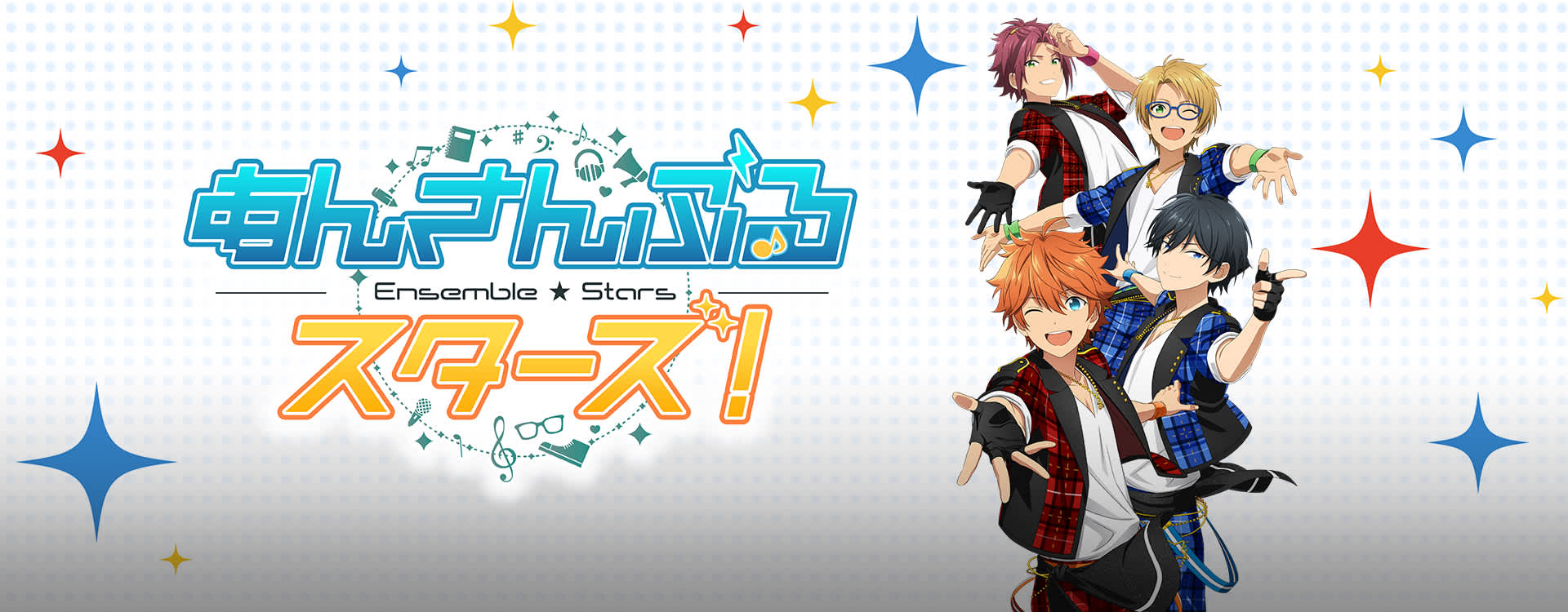
Put on your sequins and top hats, it’s time to take a dive into the land of teen stardom and exploitation! Ensemble Stars is a show about all kinds of boys (and one girl) who attend a very prestigious “Idol School” called Yumenosaki Academy. Here, entertainers of all kinds — singers, song-writers, actors, dancers, producers and so on — train to become known idols before they’ve even gotten their driver’s permits. The story mainly focuses on the idol group known as Trickstar, and their aspiring producer named Anzu. The initial plot revolves around the five of them disestablishing the favoritism and imbalanced power dynamics of the school so that lesser-known performers/idol groups at school can have just as much of a shot at success as the “more famous” students do.
Once that plot resolves itself, though, it’s pretty much just introducing new characters over and over again. Trickstar manages to break down the unfair system established against lesser known groups, and in doing so, they start to become famous in the process. The second half of the season fades Trickstar out a bit in favor of giving the viewer some more insight on other characters at the school. This is cute and all, but it feels less like a cohesive story at this point, and more like…a few vignettes strung together. It’s not bad, but it’s not as strong as the first half of the season, which had a primary focus on a central plot and characters. While many Ensemble Stars characters are interesting and fun (such as Eichi, who has more depth than half of the other characters put together) the show tends to suffer from “Too Many Cooks” Syndrome. Too many characters with too little relevance.
Which brings us to the main four: Subaru, Makoto, Mao, and Hokuto. Subaru is pretty much “the protagonist” in the show, serving as an optimistic light for the whole crew. While Makoto, Mao, and Hokuto have their own narratives, none of them shine quite as brightly as Subaru. Screen time is broken up pretty evenly between the four, but it’s apparent that more character work is put into Subaru.
…Which brings us to the most hilarious part of the show: Anzu.
There is no Anzu. This character isn’t a character. She’s poised as the narrator/lead in a desperate attempt to give the audience (of mostly girls) a character to relate to, but there is no character, here. Collectively, she has probably less than 100 lines of dialogue and it’s obvious that her only purpose was to act out the role of a first-person POV for fan-girls. The attempt at giving the show a female lead is as pathetic as it is laughable.
Now, the voice acting wasn’t the most horrendous thing in the world, but a few characters (Subaru, half of Ra*bits, that one pink-haired student council member whose name is too unimportant to remember) were really irritating to listen to. Ra*bits characters either sounded like girls or had a weird lisp (which, granted, was part of the character, but still) and among a few other characters who just straight up sounded like girls, Subaru sounded like Spongebob Squarepants. In other words — maybe skip the English dub.
The other thing about this show is that there really aren’t too many stakes. It’s a very “cutesy” show from start to finish, and in this way, it really is like High School Musical. Either way, the show has some pretty great music and some expertly well-done CGI-animation sequences. The flip from 2D to 3D animation isn’t really that jarring and it fits pretty seamlessly. For those who love some good J-pop, you may love the music album, at the very least.
Kayla Gleeson is an entertainment writer and media player, with work involved in shows such as Anthony Bourdain's "Parts Unknown" and Chicken Soup for the Soul's "Hidden Heroes." In addition to her work on BubbleBlabber, she also has dozens upon dozens of published articles for RockYou Media. Aside from immersing her life in cartoons, she loves to write and read poetry, be outdoors, go to conventions, and indulge in Alan Resnick stylings of comedy.