English Dub Season Review: Daemons of the Shadow Realm Season One
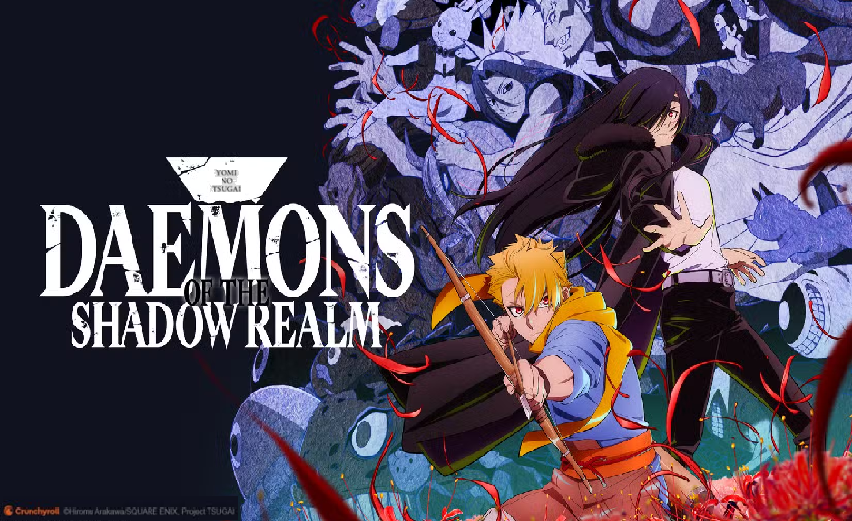
Based on the manga by Hiromu Arakawa (Fullmetal Alchemist), this story is set in a world where certain humans can control supernatural beings known as Daemons, following twin siblings Yuru and Asa, who were separated at birth and raised under vastly different circumstances: Yuru as a hunter in an isolated village, and Asa confined to a cage for a mysterious purpose. Their lives are violently upended when armed outsiders attack the village in search of Yuru, slaughtering its inhabitants and triggering a desperate attempt to reunite with his sister, only for him to encounter a shocking revelation that challenges everything he believed about her identity. Rescued by an outsider named Dera, Yuru is forced into a dangerous escape, and in a final act of desperation, he calls upon the village’s deity, summoning Daemons that begin to unveil the truth behind the chaos surrounding him. As the story unfolds, Yuru and Asa are drawn into a larger destiny tied to their prophesied ability to control all Daemons, setting them on a path toward reunion and a looming conflict that could determine the fate of the world.
On the technical side, this anime television series adaptation is produced by Bones Film and directed by Masahiro Andō, with series composition by Noboru Takagi, character designs by Nobuhiro Arai, and music composed by Kenichiro Suehiro. The first opening theme is “Tobu Toki,” performed by Vaundy, and the first ending theme is “Tobō yo,” performed by Yama, while the second opening theme is “Back Shot,” performed by Masanori Otoda, and the second ending theme is “Kujaku,” performed by Kei Sugawara.
Daemons of the Shadow Realm had plenty to live up to, especially with Hiromu Arakawa, the creator of “Fullmetal Alchemist,” behind it. Thankfully, the series establishes an identity of its own rather than relying solely on its creator’s reputation. The show itself asks the question, “What if being the chosen one/two sucked?” Across its 24-episode season, the story builds an intriguing supernatural world centered around Yuru and Asa, gradually introducing the mysteries surrounding their family, Higashi Village, the Kagemori clan, and the mysterious Daemons.
One of the series’ biggest strengths is its concept, particularly the Daemons, supernatural beings bound to humans through contracts. Their individual abilities and personalities often feel reminiscent of the “Stands” from “JoJo’s Bizarre Adventure,” while their role in the story creates plenty of possibilities for creative and unpredictable conflicts. The growing struggle over Yuru and Asa also adds tension, as various factions seek to claim their extraordinary powers. Some are relatively restrained, while others are ruthless enough to resort to murder and manipulation. The Kagemori clan occupies a more morally gray position, having questionable motives and blood on its hands while still being willing to provide Asa with a home and treat her like a person. The series also finds room for some genuinely amusing “fish out of water” humor, particularly whenever characters leave the isolated Higashi Village and experience the outside world for the first time. Their unfamiliarity with modern society and everyday customs leads to plenty of culture-shock jokes that provide some much-needed levity without completely undermining the more serious aspects of the story. Asa’s desire to live independently is another compelling element, especially after the circumstances surrounding her powers made that dream feel out of reach. Yuru’s promise that they will find a way to make it possible someday gives their relationship an optimistic edge.
The series does, however, have some notable weaknesses. Its pacing can be sluggish, with extended explanations occasionally slowing the progression of the story. The tonal shifts can also be jarring, particularly when brutal or emotionally heavy scenes are followed almost immediately by comedy. Some supporting characters receive less development than they deserve, leaving certain relationships and conflicts feeling underexplored. While the mystery-driven storytelling is often effective, the deliberate withholding of information can sometimes make the narrative feel more confusing than intriguing.
Visually, the series is one of its strongest aspects, with Studio Bones absolutely at the top of its game. The fluid animation, impressive action choreography, striking compositions, and expressive character work give the series plenty of visual impact under director Masahiro Andō. Nobuhiro Arai’s character designs complement Arakawa’s style beautifully, while the backgrounds, camera work, and occasional CGI add further polish to the presentation. Kenichiro Suehiro’s soundtrack is equally effective, enhancing tense confrontations, emotional scenes, and comedic moments while giving the series a distinctive atmosphere.
Overall, Daemons of the Shadow Realm is a strong first season that successfully separates itself from Arakawa’s previous work while establishing a compelling world of its own. Its slower pacing, tonal inconsistencies, and uneven character development keep it from being exceptional. Still, the creative Daemon system, intriguing mysteries, strong cast, and outstanding production values make it an easy series to recommend. With Season 2 already announced, there is plenty of potential for the story to expand upon its strongest ideas and take Yuru and Asa’s journey even further.