
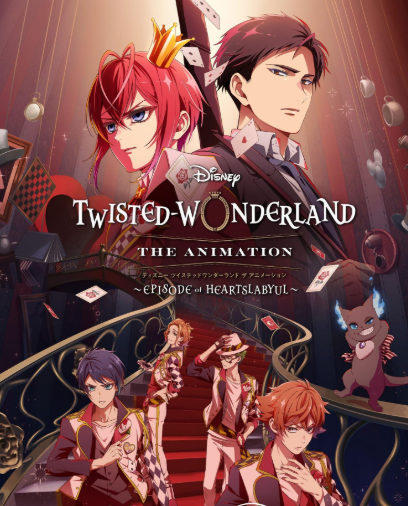
English Dub Season Review: Disney Twisted-Wonderland the Animation Season One
Disney Twisted-Wonderland the Animation is an ONA anime adaptation of a manga series published by Square Enix, which is based on a mobile game created by Aniplex. It is directed by Shin Katagai, with Takahiro Natori serving as chief director and overseeing Yoichi Kato’s scripts. It is produced by Yumeta Company and Graphinica, both of which worked on the second season of Record of Ragnarok. Yumeta Company worked on other projects like Samurai Warriors, Wolf Girl and Black Prince, and Aria the Avvenire, while Graphinica produced projects such as Expelled from Paradise, Hellsing, and Wonder Momo. Hanaka Nakano and Akane Satō designed the characters, and the game’s composer, Takumi Ozawa, returned to compose the score. The opening theme song, “Piece of my world”, is performed by Night Ravens, while the ending theme song, “Obedience”, is performed by the Heartslabyul Ryōsei (Heartslabyul Dorm Mates).
Disney has been renowned for creating the most memorable and inspirational heroes throughout its 100-year-plus history. While not all of its characters reached the heights of others, the studio has consistently crafted protagonists who resonate with audiences of all ages. However, it’s also known for delivering us their most diabolical and iconic adversaries known to man. From the mistress of all evil from Sleeping Beauty to the cunning lion uncle from The Lion King, the Disney villains take great pleasure in giving the protagonists a hard time, much to our enjoyment. Sure, we have other recent villains that are as mischievous as the ones in the past, but none of them could compare to the straightforward yet immensely charismatic rogues from our favorite classics. Not even the last-minute twist villains like Prince Hans from Frozen, nor Dawn Bellwether from Zootopia. Given their popularity, it’s no surprise that anyone wanted to capitalize on their villainous success.
In 2020, Aniplex and Walt Disney Japan teamed up to produce a mobile game that combines the Disney villains from various franchises and the world of anime. That game came to be known as Disney Twisted-Wonderland, a gacha adventure game that features handsome anime guys inspired by the biggest crooks in Disney’s history. The game, which features “Black Butler” creator Yana Toboso as its designer, blends its isekai/magic academy elements with inspirations from the classic Disney library, including Alice in Wonderland, Hercules, and The Lion King. Its success, possibly due to people staying home during the pandemic, helped the franchise expand beyond our cell phones with a manga series that adapts the game’s chapters, or “books”. Five years after its debut, Twisted-Wonderland finally made its way to our television screens as an anime adaptation on Disney+, transporting fans and newcomers into the vibrant world of Night Raven College. Given my love of anything Disney-related and anime, there was no doubt that this series was made for me, but is this villainous adaptation worthy of carrying the studio’s legacy?
Back when the anime was first announced, Twisted-Wonderland was planned to cover the first three manga volumes across three seasons. Its first season covers the beginning portion of the mobile game and the first manga adaptation, titled “Episode of Heartslabyul”. Consisting of eight episodes, the season chronicles Yuuken Enma (Jonathan Ha), a student who is unexpectedly summoned to another world by the magic mirror, despite his lack of magic. With no way home, Yuu attends Night Raven College, a magical school known for its dormitories inspired by classic Disney villains. Along with his allies, Ace Trappola (Max Mittelman), Deuce Spade (Hunter McCoy), and a magic cat monster named Grim (Ben Diskin), Yuu finds himself encountering the Heartslabyul dorm, led by its strict and short-tempered Housewarden, Riddle Rosehearts (Paul Castro Jr.). Riddle’s obsession with following the Queen of Hearts’ guidelines forces the group to confront the Housewarden, ultimately leading them to face a deadly consequence that poses a risk not just to the academy but also to Riddle’s own life.
Essentially, Twisted-Wonderland is yet another isekai/magical academy anime we’ve seen numerous times, but with plenty of Disney magic sprinkled on top of it. While I haven’t played the game myself, I was nonetheless intrigued by its concept of handsome anime men resembling the Disney baddies. Plus, I didn’t mind an isekai anime or two as long as its execution maintains my interest. As a result, the show faces the challenge of impressing its fanbase, newcomers unfamiliar with the franchise, and even Disney fanatics with its faithfulness and presentation. Unsurprisingly, I belonged to the latter two categories. After watching the first three episodes, I was initially hesitant about how its execution would play out within its formula, despite the refreshing twist on its Disney essence. But afterward, I was completely surprised by how good it turned out. It’s not just the nostalgia from seeing several Easter eggs from our favorite Disney classics. Instead, it’s due to how the series utilized this nostalgia to deliver an invigorating adaptation of the villainous magic academy.
Of course, even with its twist involving the Disney villains, Twisted-Wonderland is another series that follows the similar narrative guidelines of the traditional isekai and magic academy anime. It’s somewhat akin to abiding by the rules designed by the Queen of Hearts. It’s crucial to appease the genre’s followers, but it can also be insufferable for those wanting it to bend the rules a bit. Nonetheless, it retained the genre’s magic through its narrative and world-building. “Episode of Heartslabyul” serves as an introduction to Night Raven College, detailing its settings and functions as seen in the games, except for the option to change the protagonist’s name. It features several dorms inspired by specific Disney villains, along with characters and activities inspired by those villains’ personalities. One example is Riddle, whose rigorous, arrogant persona matches the short-tempered Queen of Hearts from Alice in Wonderland. This can come across as Disney’s version of Harry Potter in the dorm names, but the season made a sincere effort to ensure its story is not a carbon copy of the iconic book series. Additionally, the season clearly took its time to underscore the world-building amid its plot involving Riddle’s rule-abiding tyranny, especially its teases of what’s to come in the upcoming seasons. Fortunately, it didn’t reach the point where the narrative came to a complete halt.
Its story was another element that enhanced my enjoyment of Twisted-Wonderland. While familiar by design, the first season offered a pretty decent exploration of following rules and even generational trauma. These themes originated from Heartslabyul’s Housewarden, Riddle, who was raised by his stricter mother to abide by the guidelines or face punishment. Of course, by punishment, I mean “lose your head”. His mother’s teachings made Riddle as ruthless and controlling as she was, leading him to severely punish his students whenever they broke his rules or angered him with their resilience. Even worse, it forces Riddle to face the life-threatening consequences of abusing his authority. It highlights that following the rules can help someone become a better person, but can also cause mental harm to everyone, including the rule-giver, if taken too far. It can even cause the latter to lose their followers’ trust if their temper is left unchecked.
At first glance, Riddle may seem like an egotistical, cranky asshole who prioritizes the Queen of Hearts’ bizarrely strict guidelines over his students’ sanity. However, the season’s sixth episode, “An Army of One”, paints a deeper picture of the Housewarden’s background, portraying him as a victim of generational trauma stemming from his mother’s teachings. This makes Riddle another “antagonist” whose actions make me want to decapitate his head, but also make me feel bad for what he’d been through regarding his origins. Of course, who better to convey a character like Riddle than Paul Castro Jr.? Castro Jr.’s performance was easily the season’s main highlight in the English dub, as he effectively channeled the raw, lively fury and tyrannical essence of Riddle. It’s far from perfect, but it’s another example of the merits of an anime’s overseas dub.
Regarding the other characters, the only one who was hit-and-miss for me was the protagonist, Yuu. Yuu is basically another isekai protagonist who got stuck in another world at the wrong time. Of course, with his lack of magic, he’s left at a disadvantage against those who have it. Initially, this could’ve led him to discover the power within himself, but the season left him feeling underutilized most of the time. Much like the game, Yuu is characterized as the audience’s perspective on the story unfolding before them. There were moments that could lead to Yuu’s potential development in later seasons, and Jonathan Ha was decent with what he was given for his vocal performance. However, regarding his first impression, I didn’t find myself caring for him as much as I did for the show’s supporting characters. Maybe that will change once the second season comes out?
The idea of transforming Disney villains into handsome anime men may be seen as a bizarre way to capitalize on their popularity. As if introducing the villains’ children via the Descendants films wasn’t puzzling enough. But Disney Twisted-Wonderland managed to make this strange concept work through its world-building and character designs. Its long-awaited anime adaptation followed suit with a faithful, suitably heartfelt, and entertaining introduction to the isekai world that blends anime flair with Disney magic. While it offers several tropes seen in other isekai and magical academy anime, Disney Twisted-Wonderland the Animation showed promising signs of another successful expansion of the franchise and the Disney catalog. Its world-building provides enough intrigue to carry its engaging plot and Easter eggs, and its serviceable animation underscores the vibrancy of its settings, character designs, and Disney nostalgia. Fans of the mobile game will likely enjoy the adaptation for its faithfulness, while Disney followers will appreciate it for its inspirations that make them recall their favorite childhood films.







"There are also other characters that come and go (also owned by the Warner Bros. Discovery conglomerate media company)."
Huh. Is that just referring to other characters from the show itself, or is this implying that the new season is going to have cameos from other WBD IPs