English Dub Season Review: Golden Kamuy Season Five
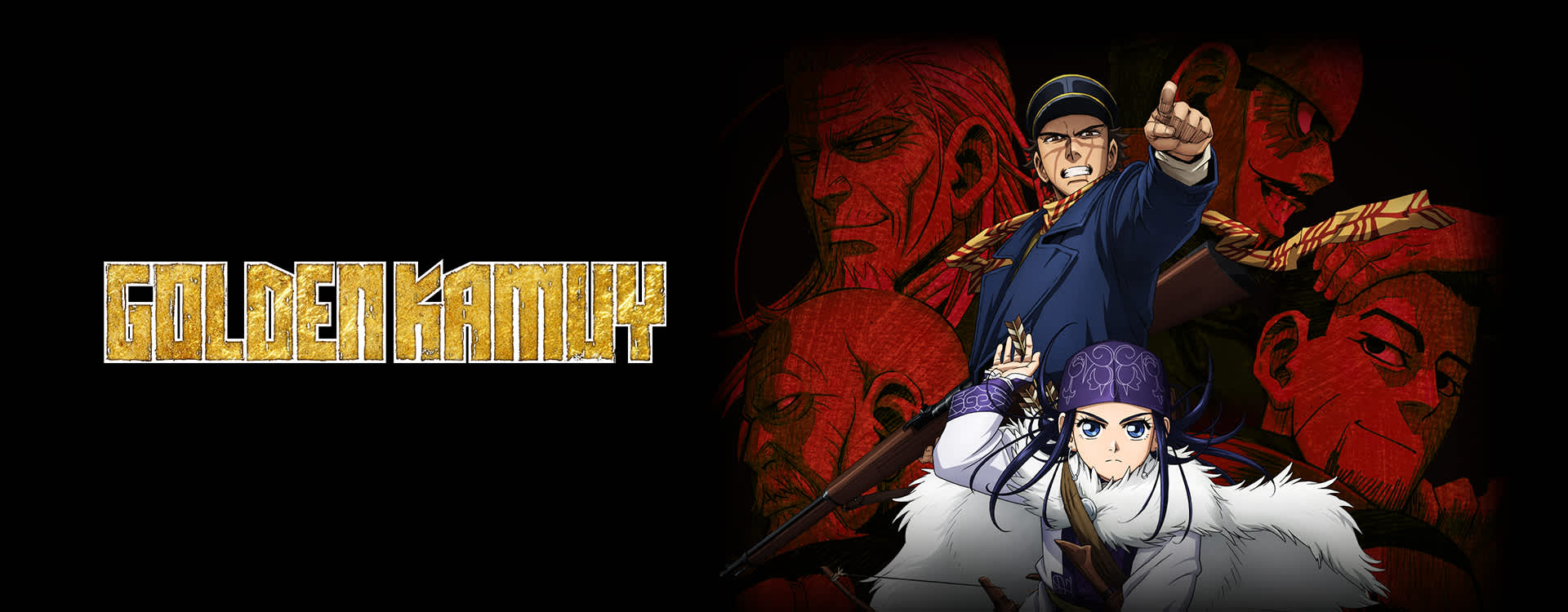
Sugimoto and his group have come to Sapporo in pursuit of escaped prisoner Uechi Keiji. While there, scouts from the 7th Division, led by Lieutenant Tsurumi, and Hijikata’s gang are searching for a serial killer who is believed to be the escaped prisoner, and the factions fighting over Ainu gold have converged in Sapporo. Meanwhile, Ushiyama and Toni encounter Uechi, who is about to commit a new crime. Ushiyama breaks into a Western-style restaurant in pursuit of Uechi, but Sugimoto and his friends are eating inside. Hijikata also shows up, and the situation becomes tense…!!
On the technical side, the fifth and (Sort of) final season of Golden Kamuy was animated by Brains Base and continues under the established core staff, with Hitoshi Nanba directing, Noboru Takagi handling series composition, and Kenichiro Suehiro composing the music. Kenichi Ohnuki returns for character design, while Koji Watanabe handles firearms design, Shinya Anasuma designs props, and Ryō Sumiyoshi is responsible for animal design. CG direction is overseen by Yuuko Okumura and Yasutaka Hamada, and Hiroshi Nakagawa continues as Ainu language supervisor, maintaining linguistic and cultural authenticity throughout the production. The Opening Theme was “Golden Horizon” by Awich × ALI, while the ending Theme, “The Ballad,” was by Ken Yokoyama.
This fifth and presumed “final” season continues to prove just how rare and gripping long-form, multi-threaded storytelling can be in anime. It remains genuinely exciting to watch unfold in animated form, which says a lot about the strength of the source material and its adaptation. There’s an impressive balance here between intense, high-stakes developments and moments of absurd humor that break up the tension without undermining it, keeping the series tonally dynamic and engaging throughout.
More than anything, this season feels increasingly character-driven rather than purely plot-focused. Figures like Wilk, Kiroranke, and Tsurumi each present compelling and logically consistent motivations, and their conflicting ideologies are supported by breadcrumbs established earlier in the series. Tsurumi, in particular, continues to dominate scenes with his unsettling presence, though his near-constant survival can start to feel like excessive plot armor. On the other hand, Ogata’s storyline stands out as especially absorbing, often pulling attention away from the broader conflict due to how unpredictable and layered his role has become.
In terms of structure and pacing, certain arcs land more strongly than others. The Beer Factory arc, for instance, delivers a tighter and more satisfying experience compared to the broader chaos of the Goryokaku battle. Episode 6 is a clear standout, showcasing confident storytelling and strong execution in both writing and direction. However, the season’s conclusion feels less like a definitive finale and more like an extended setup for what comes next, especially with its abrupt cliffhanger and the sense that the narrative simply pauses mid-trajectory. The heavy promotion of this being the “final season” also feels misleading, even if the decision avoids rushing the story to an unsatisfying end when they could’ve changed the episode count to 24 or more instead of 12.
On the production side, the animation fluctuates between solid and slightly inconsistent, occasionally leaning into a rough or almost comedic stiffness that oddly enhances the series’ charm rather than detracting from it. Action sequences still carry weight and clarity, even if they don’t always reach peak visual polish compared to earlier parts of the series. The music, meanwhile, remains impactful in key moments, with the opening and ending themes standing out more than the background score, which at times feels less prominent than expected for a series of this scale. Despite these inconsistencies, the audiovisual presentation still supports the storytelling effectively enough to keep engagement high.
Overall, this season delivers strong storytelling momentum, rich character conflicts, and several memorable arcs, but ultimately feels incomplete in isolation due to its abrupt stopping point and the marketing of it as a final installment. Much like how Attack on Titan’s final season infamously stretched itself with random waves of episodes before reaching the big definitive finale, sadly, this was the case here… but thankfully, later this winter, we’re supposed to get another story arc to hopefully finish it for good. While it avoids rushing a conclusion, which is commendable, it also leaves the narrative hanging in a way that may frustrate viewers expecting closure, and keeps me from giving this a higher rating. Even so, the strength of the writing and characters ensures it remains an engaging and worthwhile continuation of the series, with the understanding that the real conclusion is hopefully still ahead.