


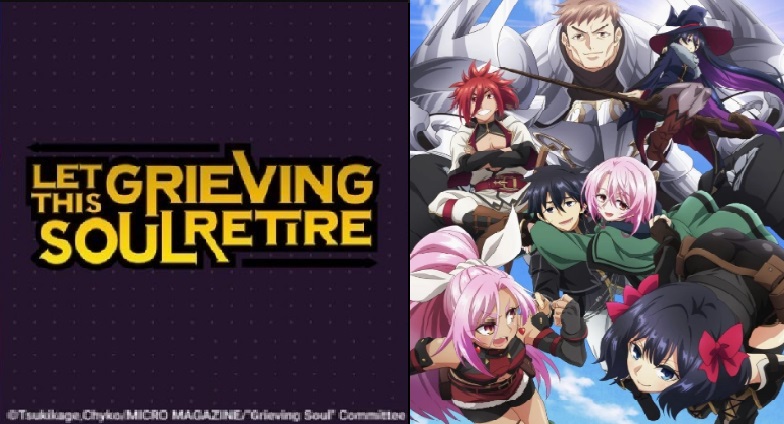
English Dub Season Review: Let This Grieving Soul Retire Season One
Based on the Japanese light novel series by Tsukikage and illustrated by Chyko, Let This Grieving Soul Retire follows Krai Andrey, a supposed prodigy hunter in a world where treasure hunters brave dungeon-like vaults for relics and glory, though in reality he’s a complete weakling whose luck, misunderstandings, and the overwhelming strength of his childhood friends create the illusion that he’s the most skilled among them. As six kids once vowed to become treasure hunters and eventually grew into the strongest heroes in the imperial capital of Zebrudia, Krai quickly realized during his very first quest that he wasn’t cut out for the job, yet his friends nonetheless placed him at their head, forming the legendary party known as the Grieving Souls. While the world believes he commands a vast array of abilities, Krai has no special talent at all, and every success attributed to him is actually the work of his overpowered companions along with a vast collection of magical relics (Some useful and some are defective) that he cleverly finds ways to put into practical use, earning him the nickname “Thousand Tricks”. Yet despite his repeated attempts to quit out of fear that he’ll be a liability, everyone around him interprets his panic as brilliance, leaving him trapped in a reluctant hero’s journey filled with glory, headaches, and constant attempts to retire early.
On the technical side, this anime television series adaptation was produced by Zero-G and directed by Masahiro Takata, with series composition by Hideki Shirane, Yūsuke Isouchi, and Shingo Fujisaki designing the characters, and Ryōhei Sataka composing the music. The opening theme song is “Tomorrow; Conflict Tomorrow”, performed by Lezel, while the ending theme song is “Scream!”, performed by Pmaru-sama. Following the airing of the final episode of the first part, the second cour’s opening theme song, “Algorithm”, was performed by Kiyono Yasuno, while the ending theme song, “Fragment of a Dream”, was performed by Iris.
At its core, the show’s strength lies in its absurd yet cleverly sustained premise: Krai is celebrated as a legendary mastermind despite being completely average, and every attempt he makes to avoid responsibility somehow reinforces his myth. At times, his portrayal drifts a little too far into exaggerated foolishness rather than the more subtle, laid-back avoidance that made him so charming early on. Still, the constant cascade of misunderstandings and the creative ways conflicts resolve themselves keep the narrative consistently engaging.
Season one’s two halves shine in different ways. The first half establishes the characters, the running gags, and the rhythm of its misunderstanding-driven comedy, while the latter half leans further into chaotic escalation and increasingly outrageous scenarios. Much of the humor genuinely lands, ranging from deadpan reactions to full-blown absurd set pieces, whether it’s ghostly antics, over-the-top transformations, or Krai’s accidental “master plans” unfolding around him. The show rarely takes itself too seriously, and that commitment to silliness becomes one of its greatest strengths.
The cast dynamic remains a major highlight. Even when certain characters feel underexplored or occasionally repetitive, the ensemble chemistry carries the experience. Krai himself continues to be the make-or-break element: when his panic subtly masks accidental competence, the formula feels sharp and satisfying; when his indirect antics become too much of a pure gag, it slightly dulls the impact. Fortunately, the supporting characters within and outside Krai’s circle, through their loyalty, frustration, and blind admiration, constantly elevate the material and keep the momentum lively.
From a production standpoint, the animation handles expressive comedy particularly well. Exaggerated facial reactions, playful creature designs, and stylized transformations are animated with energy and personality. The soundtrack supports both comedic timing and heightened tension effectively, while the voice acting remains consistently strong, often enhancing punchlines through delivery alone. The series even encourages viewers to stick around during and sometimes after the credits of every episode, where extra comedic bits and creative preview segments are shown that further add to the fun proceedings.
Overall, Season one delivers a refreshing, self-aware fantasy comedy that fully embraces its chaotic identity. Across its 24 episodes, both halves succeed in different ways as it balances the setups and payoffs while maintaining a steady stream of humor that thrives on escalating absurdity and character dynamics. The series ultimately lives and dies by Krai’s portrayal; when his accidental “genius” is paired with just enough awareness, the formula feels sharp and hilariously distinct from typical overpowered-protagonist stories. Even when pacing or characterization occasionally feels uneven, or when the humor leans too heavily into exaggerated stupidity, the show remains consistently fun, unpredictable, and easy to binge. It may sacrifice some depth for the sake of comedy, but its unwavering commitment to absurdity and ensemble-driven chaos makes it a uniquely entertaining experience. While there is currently no official announcement of a Season 2, the strong foundation laid here leaves plenty of room for continuation, one that would be more than welcome.














"There are also other characters that come and go (also owned by the Warner Bros. Discovery conglomerate media company)."
Huh. Is that just referring to other characters from the show itself, or is this implying that the new season is going to have cameos from other WBD IPs