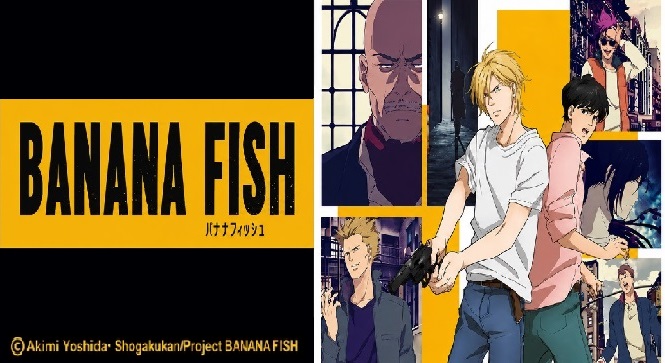
English Dub Season Review: Banana Fish
Based on the Japanese manga series written and illustrated by Akimi Yoshida, Banana Fish follows 17-year-old Ash Lynx, a runaway turned gang leader who was raised by New York City mafia boss Dino Golzine. While investigating the mysterious phrase “Banana Fish,” which his older brother Griffin has repeatedly muttered since returning from the Iraq War. Ash’s search brings him into contact with Eiji Okumura, a young Japanese photographer’s assistant visiting New York to document its street gangs. However, their meeting is cut short when Dino’s men attack Ash’s hideout and kidnap Eiji and Ash’s friend Skip, forcing Ash to rescue them while continuing his investigation into the mystery surrounding Banana Fish.
On the technical side, this self-contained 24-episode anime series was produced by MAPPA and directed by Hiroko Utsumi as part of a commemorative project celebrating manga artist Yoshida’s 40th anniversary, with Hiroshi Seko handling series composition, Akemi Hayashi designing the characters, and Shinichi Osawa serving as sound director and composing the music. The series features four theme songs, with “found & lost” by Survive Said The Prophet and “Prayer X” by King Gnu serving as the opening and ending themes for the first half, while “Freedom” by Blue Encount and “Red” by Survive Said The Prophet take over from episode 14 onward.
At first glance, Banana Fish sounds like a title that could belong to almost anything except the gay romance/action/crime drama/thriller it actually is. Beneath its strange name is a surprisingly profound story about organized crime, abuse, trauma, revenge, and the desperate pursuit of freedom. Set within New York’s criminal underworld, the series follows Ash Lynx, a brilliant seventeen-year-old New York gang leader who is also a gay male prostitute, trapped under the control of mafia boss Dino Golzine. While investigating the mysterious drug known as Banana Fish, Ash becomes acquainted with Eiji Okumura, a sheltered but kind Japanese photographer’s assistant whose presence gradually becomes far more important to him than either of them initially realizes. Their contrasting personalities complement each other remarkably well, laying the foundation for one of the series’ greatest strengths, but more on that later.
What makes Banana Fish particularly distinctive is its unusual fusion of crime-thriller tropes & conventions with much heavier subject matter. At times, it’s like watching the anime version of a gritty Hood Movie, filled with gang rivalries, drug deals, betrayals, shootouts, police corruption, and larger-than-life criminals. Yet beneath those familiar tropes is a story that carries the bleak seriousness of a Law & Order: SVU episode, particularly in its treatment of sexual violence, child exploitation, trafficking, and the long-term effects of abuse. What makes these elements especially disturbing is how casually the villains treat them. Characters like Golzine, for example, don’t simply commit abhorrent acts; they discuss and carry them out with an unsettling lack of hesitation or remorse, as though they’re just another part of doing business. That disturbing indifference arguably makes them more horrifying than loud, obnoxious, cackling caricatures like The Joker, because there’s something uniquely terrifying about villains who treat monstrous acts as completely ordinary. Their casual acceptance of cruelty creates the unsettling impression that such behavior has become deeply ingrained within their world. However, the series isn’t always subtle in how frequently it returns to these subjects, and its predominantly male cast creates an oddly narrow depiction of sexual violence. While men are overwhelmingly portrayed as victims of abuse at the hands of other cruel, sadistic, and deviant men, women are also victims of sexual violence, yet their experiences receive comparatively little attention. This creates an unfortunate imbalance in a story that otherwise goes to considerable lengths to explore the lasting consequences of abuse and trauma. Even so, Banana Fish consistently treats that trauma as something with lasting consequences rather than simply using it as background material.
The anime also faced the considerable challenge of adapting a manga that ran from 1985 to 1994 across 19 volumes into only 24 episodes. Several elements were modernized, including replacing the manga’s Vietnam War references with the Iraq War and introducing technology such as smartphones. The series also has a distinctive literary touch, with several episode titles referencing famous works of literature and giving the story an additional layer of identity. Despite these updates, the anime remarkably preserves the gritty atmosphere of its source material while making New York feel like a genuine part of the story. Ash remains the clear standout and emotional backbone of the series: intelligent, charismatic, ruthless, and extraordinarily capable, yet deeply traumatized by a life in which he was never allowed to simply be a normal teenager. His willingness to commit violence and detach himself from his own morality when survival demands it makes his vulnerability around Eiji all the more impactful. Eiji’s kindness and innocence provide a stark contrast to Ash’s violent world, gradually making him the person Ash trusts most and the one who brings out the side of himself he normally keeps buried. To Ash, Eiji represents the peaceful childhood and ordinary future he was denied, giving him something worth protecting and a reason to imagine a life beyond violence. Their bond becomes one of the series’ greatest emotional strengths, while the supporting cast also features several memorable personalities, including Shorter, Max, Sing, Yut-Lung, Blanca, Arthur, and Golzine. Unfortunately, the rapid pacing means characters are constantly being kidnapped, rescued, captured, and thrown into another crisis, sometimes leaving emotional moments and supporting characters less developed than they could have been.
Visually, MAPPA gives Banana Fish a gritty and grounded aesthetic that fits its subject matter exceptionally well. The animation is generally fluid and expressive, particularly during the action sequences and quieter moments between Ash and Eiji, although there are occasional shortcuts, still frames, and limited background animation. Its environments and color palette help create a convincing, and at times colorful, version of New York, contrasting the city’s beauty with the ugliness hidden beneath it. The soundtrack is another major strength, with songs such as “found & lost,” “Prayer X,” “Freedom,” and “Red” reinforcing the emotional progression of the story. But perhaps the strangest part of the show’s history is how long English-speaking fans had to wait for an official dub. Banana Fish originally aired in 2018, yet went eight full years without one. In 2025, Amazon Prime Video briefly attempted to fill that gap with an AI-generated dub, only for it to be removed after widespread backlash. Netflix eventually acquired the rights and produced a new dub featuring real human actors such as Brandon McInnis as Ash, Jonathan Tanigaki as Eiji, Keith Silverstein as Max, and Christopher Swingle as Dino, to name a few. After nearly a decade of waiting, Banana Fish finally received its first legitimate English-language dub in 2026, giving fans the proper release the series should have had from the beginning.
Overall, now that Banana Fish finally has a proper English dub, there’s really no excuse not to give it a shot, although newcomers should know right away that this is absolutely not a show for the faint of heart. With its diverse cast, LGBTQ+ themes, and willingness to tackle its super fucked up subject matter, it almost feels tailor-made for Netflix’s modern DEI checklist, except this story was doing all of that long before Netflix existed. Its pacing can be frantic, its plot occasionally stretches believability, and its depiction of trauma isn’t always handled with the subtlety it deserves, but Ash and Eiji’s relationship gives the story its emotional core and lasting impact. Beneath the gunfights, gang wars, conspiracies, and larger-than-life villains is ultimately a story about a boy trying to discover whether someone whose innocence was taken from him is worthy of happiness. Banana Fish may leave you angry, exhausted, and emotionally devastated, but the fact that people are still talking about it more than eight years after its original airing, long before it ever received an English dub, proves just how deeply it can linger, even long after the credits roll. So if you’re new to Banana Fish, watch at your own risk…