


The Beautiful, Twisted Anti-Fables of Alberto Vázquez


Interview By Reyan Mishra
Story By John Schwarz
THE AIR IN THE ROOM (while on the phone) shifts when Alberto Vázquez talks about his characters. On a screen, they look like the kind of adorable, wide-eyed woodland creatures that spent the last century collecting Disney royalties. But in Vázquez’s hands, these innocent archetypes are thrust into brutal, hallucinatory landscapes of psychological warfare, existential dread, and moral decay.
In a cinematic landscape where feature animation is treated like a safe, heavily focus-grouped playground for children, the Spanish director has spent the last decade acting as its chief subversively minded vanguard. His films don’t offer the comforting, warm blanket of a neat moral resolution. Instead, they force us to look into the mirror.
“My cinema doesn’t aim to please everyone,” Vázquez says, leaning back with the quiet confidence of a filmmaker who has earned the right to discomfort his audience. “Animation is a medium for telling all kinds of stories. Just as live-action cinema features horror or drama, the same is possible here.”
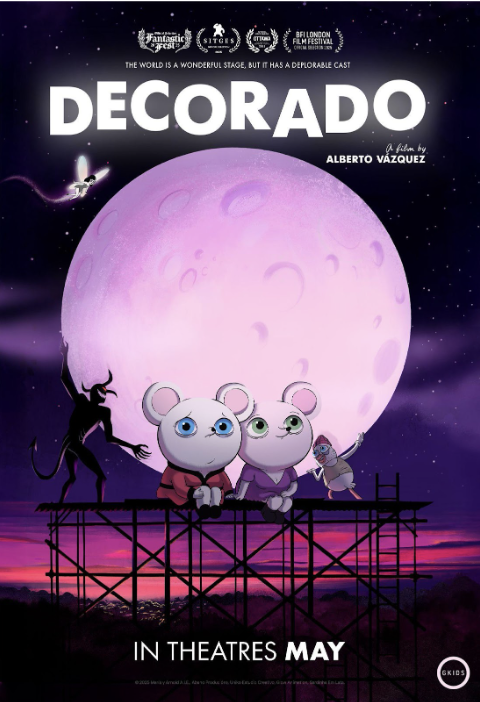
We are sitting down to discuss his latest feature film—his third consecutive project to be snapped up for international distribution by indie powerhouse GKIDS. It marks a dazzling evolution for the auteur. If his cult-classic debut Psiconautas: The Forgotten Children was a muted, monochromatic punk-rock cry, and Unicorn Wars was a neon-drenched, apocalyptic fever dream, his new project is something entirely different: a beautifully structured, color-blocked masterpiece that reinvents a universe he first explored years ago.
From Underground Gags to Classical Scope
The film’s DNA traces back to Decorado, his acclaimed, pitch-black short film that played like a 19th-century etching brought to life by a cynical nihilist. But stretching an underground short into a grand cinematic statement required a total overhaul of his creative architecture.
“When I made the short, I didn’t expect to make a feature film,” Vázquez admits. “The short has a narrative style full of wild gags and lacking a clear structure.”
The turning point came when he teamed up with co-screenwriter Xavi Manuel. Originally plotting a mature, episodic animated series, the duo realized they had generated too much gold to let it vanish into development hell. “The series didn’t get picked up, so we said: ‘Well, given all the work we’ve already put in, let’s turn it into a feature film instead.'”
But translating that raw, chaotic energy to a 90-minute runtime was a trial by fire. The underground gags that killed in a short format fell flat over an hour and a half.
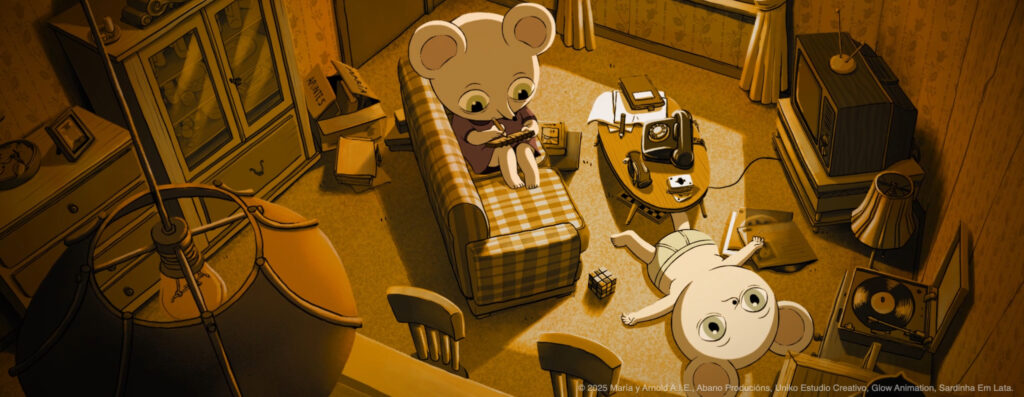
“We ultimately settled on a more classical narrative approach,” Vázquez explains. “We also felt that the aesthetic of the short film—black-and-white featuring 19th-century engravings—was too stark for a feature-length film. We wanted to harness the expressive possibilities of color and make it visually more approachable.”
The result is what he calls an “anti-fable”—a story starring little animals that tackles the illusion of human freedom and the crushing weight of an artificial, controlled world. Yet, beneath the cynicism, there is a beating heart. “It speaks of how real bonds—love, friendship, intimacy—can save us from that artificiality,” he says.
The 600-Animatic Agony
To hear Vázquez talk about the actual process of filmmaking is to understand the grueling, obsessive toll of independent animation. It is a medium measured not in days or weeks, but in half-decades.
“I don’t like watching the films I make—at least, not right after I finish them,” he confesses. “A year has to pass first. That’s because all I see are mistakes. When I finished this one, I was tormented; I thought it wasn’t good, that it was riddled with flaws. That happens to me with every film.”
“During the process itself, it’s a very obsessive experience. I must have watched the animatic 600 times. That’s just the nature of this work: it takes many years—five or six on average. You change as a person during that time; you get tired of it, you fall back in love with it, you get bored with it again… it’s a real rollercoaster.”
To survive the ride without repeating himself, Vázquez chose to share the steering wheel. For the first time, he relinquished his tight grip on the art direction, bringing in acclaimed Spanish illustrator José Luis Ágreda to help shape the film’s vibrant, mid-century aesthetic.
The collaboration yielded a breathtaking, minimalist visual language inspired by legendary Disney concept artist Mary Blair. “We wanted the color palette to be both expressive and narrative—closely tied to the characters’ emotional states,” Vázquez says. “There are very few colors used per scene—typically just two distinct tones and their various blends. It’s a highly illustrative style, very much akin to classic poster art.”
This visual restraint is anchored by a massive, dualistic score crafted by long-time collaborators Joseba Beristain and Víctor García—a sonic landscape where classical cello and piano collide with ambient electronic soundscapes.

The Uncertain Horizon
As an auteur, Vázquez is arguably at the peak of his powers. With a trusted, battle-tested crew by his side, he managed to pull off the unthinkable: securing funding and wrapping production on his new film in a lightning-fast four years. “Ultimately, the accolades—and the fact that the films perform well—are what make it easier for you to get another project off the ground,” he notes.
Yet, even as his own star rises, Vázquez casts a worried eye at the industry at large. He laments the homogeneity of Western animation, pointing to the fearless diversity of Japanese anime as the standard the rest of the world should be striving for.
But his deepest anxiety is reserved for the looming tech storm threatening to alter the medium permanently. When asked about the rise of artificial intelligence, the director’s tone turns sobering.
“I see it as a complicated situation,” Vázquez says quietly. “It’s already widely accepted that within four or five years, 95 percent of films will be produced using artificial intelligence. That is going to change everything. Whereas my film required a crew of 200 people, future films might require only 20.”
It’s a dark twist worthy of one of his own scripts—a future where a hyper-saturation of content could cheapen the very art form he has dedicated his life to defending.
“There will likely be a massive surge in the number of films being made,” he says, “It’s already hard enough to keep up with everything now; just imagine what it will be like if production volume multiplies exponentially. It’s a rather unsettling prospect. I just hope the outcome is positive—at least from an artistic standpoint.”
Whatever the future holds, one thing is certain: as long as Alberto Vázquez is holding the pen, animation will never be forced to play nice.
Decorado is in theaters May 15th in both English language and Spanish language adaptations. Read this interview en espanol via Bubbleblabber LATAM.