Season Review: Bass x Machina Season One
OVERVIEW:
After the Civil War, dangers from supernatural magicians to inventors developing sinister weapons flood the Wild West. When a missing persons case quickly spirals into a dangerous conspiracy, lawman Bass Reeves must face these threats and prevent another war.
OUR TAKE:
Being announced alongside Cyberpunk: Edgerunners 2 and the second season of Blue Eye Samurai, which had widely successful first seasons, put a lot of expectations on Bass x Machina to succeed. Its historical treatment of race has drawn many comparisons to Blue Eye Samurai, which feels rather accurate.
The worldbuilding mostly follows real American history in its post-Civil War era. The series mentions real-life Buffalo Soldiers, scattered Confederates, and even a one-off mention of Union General William Sherman. While they don’t appear to have changed the outcome of history, this alternate world introduces advanced steam technology called “boilertech.” The most we see of this technology are robotic manservants and mech suits of various sizes. Dana’s own inventions are the most diverse of these inventions. Bass x Machina doesn’t explore the use of this technology in everyday life, though perhaps this is intentional for boilertech being rare. Still, it would’ve been fun seeing more interactions with boilertech robots speaking like R2-D2 and other astromechs from Star Wars.
Boilertech isn’t exclusive to whites, as one Native American character specializes in hydroelectricity and smithing with a rare metal called Aianhli. At one point, that same character claims magic is simply a word for things white folks don’t understand. Ironically, the same episode establishes beforehand that magic actually exists under the Chahta Hvshtahli, or simply the Sacred People. Having both magic and technology in one setting isn’t a dealbreaker for me, especially given the show’s racial context. This may, however, deter viewers hoping for pure steampunk.
Bass x Machina is further enhanced by its visuals. The art style and animation are reminiscent of another Netflix animated series, Castlevania. While the genres of dark fantasy and steampunk are wildly different, its visual tone, balance of both 2D and 3D animation, and bloody portrayals of violence feel similar. While the art is good, Roman Gianarthur’s music enhances the storytelling even further. The whole soundtrack covers almost every genre, but mostly funk, hip-hop, and soul. Janelle Monáe’s “Honor Killing” is a memorable theme song perfectly establishing the lowdown, grittiness of the West.
Other lyrical songs from popular black artists that make many shootouts especially memorable include Kendrick Lamar’s “Blacker the Berry,” Charles Bradley’s “Ain’t It A Sin,” and Paris Texas’s “Bullet Man.” The instrumentals are mostly retrofunk tracks following the same patterns from most Old Westerns, but with a twist. These range from slowed-down lo-fi, hip-hop inspired percussion, and rock. It even dips into folk music with woodwinds for scenes focusing on the Native Americans. Undoubtedly, the music choice is what makes Bass x Machina memorable.
The smaller but no less important themes of the story center around identity. Dana is the main focus for this subplot, showing low confidence but undeniable skill in the first few episodes. It’s not until Episode 3 that someone pushes her to follow her path and to “stop asking the world permission to be who you know you are.” She embraces this confidence accepting her dual racial identity in Episode 4, and fully realizes it when she strikes out on her own in Episode 5.
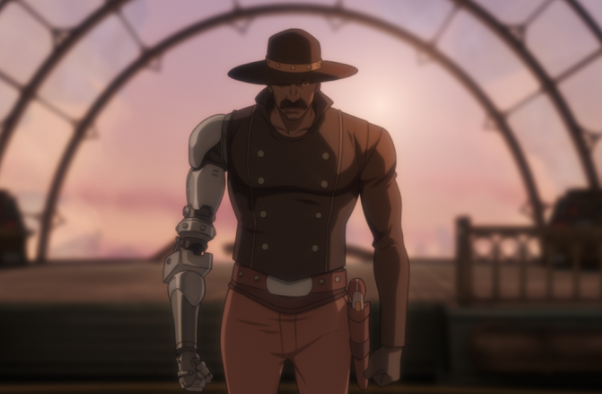
Of course, the biggest themes center around race and oppression as a person of color. From halved payments for people of color to segregation in establishments, Bass x Machina gets across the challenges African-Americans and Native Americans of the time faced frighteningly well. Reeves in particular endured additional prejudice due to his boilertech prosthetic, though the implications of being more mechanical and less human was sadly not fully explored. The showrunners also tied race to messages of war and cyclical violence. Throughout the series, the antagonists embrace their indignant rage and adopt the worst traits of their oppressors to fight back. On the flipside, Reeves struggles to not let that wrath kill his own humanity, marking him as a traitor to his own kind. Episode 4 treats this struggle best, stating through Dana that the common good isn’t determined by race. This is the ‘side’ Reeves definitively stands for.
Past the first four episodes, the themes of race start becoming particularly heavy-handed. The first crack in Episode 5 and beyond’s storytelling is when Reeves tries talking Ahni down from her singleminded obsession for war and revenge. Ironically, he fall into his own obsession with Rivenbark not long afterwards. Though, succumbing to anger seeing the face of the man responsible for your torture and mutilation is understandable. It’s not as confusing as his affirmation to kill Rivenbark being his breaking point with Dana when she should know the evil he represents. Their separation, however, does give her character the space it needs to shine.
The show’s final episode suffers from this the most. The ‘redemption arcs’ of Ahni and the other Sacred Peoples’ could resolve themselves within the first ten minutes, but instead dragged on for over half the runtime. The message of adopting the worst of your enemies, and entering the cycle of killing is important. However, its heavy-handed portrayal is exceedingly repetitive. The visual storytelling, such as Lighthorse entering Rivenbark’s mech, delivers the message just as easily without dialogue. The protagonists could have easily stopped him before activating the self-destruct switch, making the final threat needlessly contrived. Lastly is Reeves’s acceptance of his new position, the reasoning of which does make sense but feels underdeveloped. This is especially the case when questioned against Ahni’s character.
As a final, smaller criticism, Bass x Machina doesn’t commit to either a wholly speculative setting or moderate historical accuracy. Admittedly when it comes to genres like this, historical accuracy isn’t always the main focus. But some of the story points surrounding Reeves don’t line up with the history put together about the real-life lawman. His wartime service, escape into Native American territory, and learning of their culture does line up. But while Reeves married twice in his life, Glory was neither of these womens’ names. Similarly, neither of his wives nor his children are speculated to come from Choctaw descent, too. It leaves one to wonder why the showrunners based their protagonist off a real-life historical figure when they could’ve worked being purely fictional.
While not flawless, Bass x Machina earns its spot beside Studio TRIGGER’s latest release as a top-tier Netflix animation. This leaves Amber Noizumi and Michael Green’s own show to one day stand beside them upon its release next year.
The six-episode limited series is now streaming on Netflix.