English Dub Season Review: Kill Blue Season One
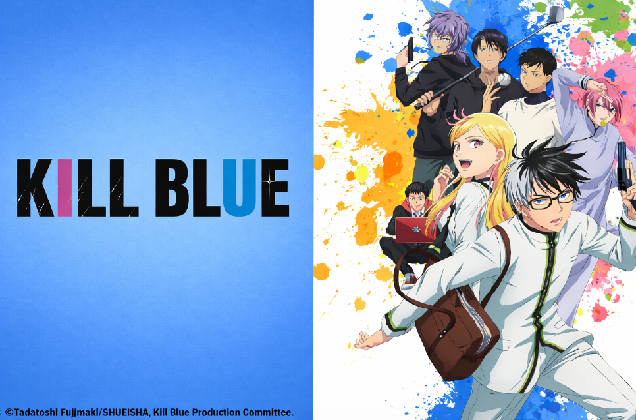
Based on the Japanese manga series by Tadatoshi Fujimaki, the story centers on Juzo Ogami, a 39-year-old elite hitman working for the Z.O.O. assassin syndicate, who is renowned for carrying out every assignment with absolute precision. While pursuing criminals connected to the genetic engineering company Mitsuoka Pharmaceuticals, Juzo’s life takes an unexpected turn when he is stung by a mysterious wasp that alters his DNA and transforms him into his 13-year-old self. With his adult body and abilities gone, he is temporarily unable to continue his career as an assassin, leading Z.O.O.’s leader to assign him a different task: enroll in the middle school his daughter intends to attend and investigate whether it is a safe place for her. Having never experienced a normal education, Juzo discovers that he unexpectedly enjoys the freedom and relationships that come with school life, forcing him to navigate the challenges of being both an ordinary student and a highly skilled killer. However, his unusual situation becomes even more complicated when he encounters Noren Mitsuoka, the heiress of Mitsuoka Pharmaceuticals, who may hold the key to restoring his original age, while dangerous forces begin to threaten the fragile balance of his new existence.
On the technical side, this anime adaptation was produced by Studio Cue and directed by Yasunori Ide, with supervision and series composition handled by Hiro Kaburagi, characters designed by Miho Daidōji, and music composed by Ryo Konishi. The opening theme song is “ATTITUDE” performed by Aespa, while the ending theme song is “KILL SHOT” performed by Riize.
At its core, while the premise may bring to mind the Case Closed/Detective Conan franchise due to its concept of an adult being trapped in a younger body, the strongest aspect of Kill Blue is its handling of Juzo’s character and the contrast between his appearance and his actual mindset. Rather than fully embracing his new teen identity, the series consistently keeps his mentality as a 39-year-old dude, allowing his experience as an assassin to clash with the unfamiliar world of middle school. This approach avoids the disturbing implications of an adult character becoming romantically involved with someone his physical age, while also creating humor from Juzo’s discomfort with typical modern teenage situations. Compared to the isolated and violent life that shaped him into a hitman, his new environment represents the childhood and relationships he was never able to experience. What begins as a simple mission to regain his original body gradually becomes a second chance at life, as Juzo starts forming genuine connections and discovering the ordinary experiences he was deprived of.
Despite its unique premise, Kill Blue does not always fully realize the possibilities inherent in its concept. While Juzo’s journey is the heart of the series, the show also introduces other young assassins who each represent different forms of dysfunction caused by their unusual upbringings. From a kung-fu prodigy who is strangely dependent on pacifiers, to other talented killers with their own personal quirks and emotional baggage, these characters highlight the strange consequences of being raised as weapons rather than ordinary children. Their interactions with Juzo create some of the series’ most entertaining moments, as his more mature outlook often clashes with their exaggerated personalities. However, despite these creative ideas, the story frequently falls back on predictable situations, repetitive jokes, and familiar school-life scenarios instead of fully exploring the depth behind its characters. The comedy can also be inconsistent, with certain running gags becoming overused, but Juzo remains the strongest element of the series thanks to his unique perspective and gradual appreciation for the normal life he was never allowed to have.
Another aspect that makes Kill Blue enjoyable is how it balances its different genres, combining action, comedy, and slice-of-life elements into a straightforward but entertaining experience. The series delivers some fun assassin conflicts and absurd situations while also focusing on Juzo’s adjustment to a world completely different from the one he knew. His interactions with classmates and Noren Mitsuoka, the heiress of Mitsuoka Pharmaceuticals who may hold the key to restoring his original body, slowly reveal that his temporary assignment has become something more meaningful. However, the story occasionally struggles with pacing and direction, as its identity shifts between being an action series, a school comedy, and a character-driven story without fully committing to one approach. While the foundation is strong, the narrative could have explored its themes and characters with more depth.
From a production standpoint, the show delivers in spades and exceeds the expectations of a typical seasonal anime. The animation is consistently solid, particularly during the action sequences, where Juzo’s assassin abilities are showcased through energetic choreography and creative use of the environment. The series features a bright, heavily saturated visual style that gives it a distinct personality, although some scenes suffer from inconsistent color choices and composition. Beyond its visuals, the anime also makes good use of its structure, with many episodes featuring post-credit scenes that are either essential to understanding the ongoing plot or help set up future conflicts and story arcs. Over the course of its 12-episode run, these additional scenes gradually expand the world, introduce new developments, and reward viewers who stick around until the very end. The soundtrack itself is somewhat mixed, but the opening theme “ATTITUDE” by aespa stands out as one of the anime’s biggest strengths, delivering a memorable and energetic introduction that immediately captures attention. While it may not be a visual masterpiece, the overall presentation, animation quality, and attention to small narrative details help elevate the adaptation and make it a more polished experience than expected.
Overall, Kill Blue is an entertaining yet flawed action-comedy that succeeds mostly through Juzo’s unique journey and the emotional potential behind its unusual premise. By keeping Juzo’s adult mindset intact despite his younger appearance, the series creates an entertaining contrast between a legendary assassin and the ordinary youth he never experienced, exploring themes of friendship, personal growth, and rediscovering life’s simple pleasures. While the anime is held back by repetitive humor, limited plot progression, and missed opportunities to fully explore its concept, it still delivers an enjoyable experience through its likable characters, entertaining action, strong opening theme, and polished animation. Although it may not reinvent the genre, Kill Blue remains a charming hidden gem with plenty of potential. Thankfully, Season 2 has already been announced, giving the series another opportunity to expand its world, develop its characters, and explore the unanswered questions surrounding Juzo’s transformation. Despite its flaws, Kill Blue remains a charming hidden gem that shows plenty of potential for what could come next.