English Dub Season Review: The Darwin Incident Season One
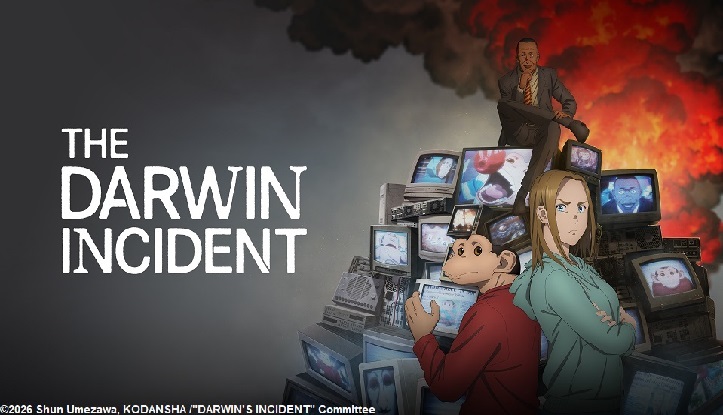
Based on the Japanese manga written and illustrated by Shun Umezawa, the story begins with the Animal Liberation Alliance, an eco-terrorist group, raiding a biological research facility and rescuing a pregnant chimpanzee, who later gives birth to Charlie, a half-human, half-chimpanzee “humanzee.” Raised quietly by human foster parents, Charlie grows up caught between two worlds, and fifteen years later, is enrolled in a regular high school in hopes of living a normal life, where he befriends a human girl named Lucy. However, his fragile peace is threatened as the increasingly radical ALA resurfaces, seeking to reclaim Charlie as a symbol for their cause, forcing him to confront his identity, his place in society, and the dangerous ideologies forming around his very existence.
On the technical side, this is an anime television series adaptation. was produced by Bellnox Films in their major debut and directed by Naokatsu Tsuda, with Katsuichi Nakayama serving as series director, Shinichi Inotsume overseeing series composition, Shinpei Tomooka designing the characters, and Alisa Okehazama and Mariko Horikawa composing the music. The opening theme is “Make Me Wonder”, performed by Official Hige Dandism, while the ending theme is “Turn It Up”, performed by Ako.
At its core, The Darwin Incident is less concerned with defining what Charlie is and more focused on how the world reacts to him as a living humanoid monkey-person. The series constructs a society that feels uncomfortably familiar, deeply polarized, performative, and quick to reduce individuals into symbols. Activists, extremists, institutions, and ordinary people all project their own beliefs onto Charlie, turning him into a battleground for ideology rather than allowing him to exist as a person. This tension is what drives the narrative, and the story is at its strongest when it avoids easy answers, instead forcing the audience to confront the flawed contradictions embedded within American culture and humanity.
Charlie himself is written with a careful balance of innocence and intelligence, positioned not as a passive observer nor as an all-knowing figure, but as someone trying to make sense of a reality that constantly misinterprets him. His emotional journey from curiosity to quiet disillusionment anchors the series, raising difficult questions about empathy, humanity, and moral consistency. Alongside him, Lucy plays a crucial role as both a grounding presence and a lens into human impulsiveness. She feels more emotionally raw and reactive, often acting before fully understanding the consequences, yet that very imperfection makes her one of the more believable characters. Their dynamic highlights the gap between Charlie’s detached reasoning and human emotion, adding a layer of intimacy to an otherwise ideologically heavy narrative.
Despite its compelling ideas, the show often buckles under the weight of its own ambition, leaning so heavily into dialogue and ideological debate that the narrative flow slows to a crawl and scenes begin to feel more like staged arguments than organic storytelling. This is especially apparent in its portrayal of the extremist animal rights group, whose oddly specific fixation on Charlie reduces him to both a symbol and a strategic tool, a concept that is intriguing on paper but executed with uneven nuance. While the series clearly aims to explore radicalization, prejudice, and ideological conflict, it frequently stumbles in delivery, with characters coming across less as fully realized individuals and more as mouthpieces for competing viewpoints. The result is a dense, sometimes preachy experience where certain perspectives are over-explained while others are oversimplified, ultimately weakening the authenticity and balance of the conflict it’s trying to present.
From a production standpoint, The Darwin Incident leans into a grounded, pseudo-realistic visual style that suits its heavy tone, though not without noticeable flaws. As the debut of Bellnox Films, a studio formed by former members of David Production, known for JoJo’s Bizarre Adventure. So there’s clear potential here, even if execution is inconsistent. Character designs can feel unconventional, and animation often turns stiff in dialogue-heavy scenes, but it holds together overall with occasional bursts of stronger action. The music and opening theme do a lot of heavy lifting, injecting energy and atmosphere where visuals fall short, while voice acting, especially across different dubs, can be hit-or-miss depending on the scene.
Overall, The Darwin Incident is an ambitious yet uneven series that leans hard on ideas over execution, delivering a premise that is as intriguing as it is challenging. The dynamic between Charlie and Lucy, combined with the extremist animal rights group’s obsessive interest in him, fuels tension and moral complexity throughout, even if heavy-handed messaging and uneven characterization sometimes undercut the narrative’s impact. Inconsistent writing and occasionally stilted dialogue can frustrate viewers, but the show shines when it explores uncomfortable philosophical and social questions, forcing the audience to confront biases, ideology, and ethical dilemmas. While there’s no official word on a continuation, the season’s ending was one hell of a cliffhanger, hinting at a potential second season that could further develop its provocative themes. For those willing to overlook its flaws, the series offers a uniquely thought-provoking and engaging experience, one that lingers long after the credits roll.