English Dub Season Review: SHIBOYUGI: Playing Death Games to Put Food on the Table Season One
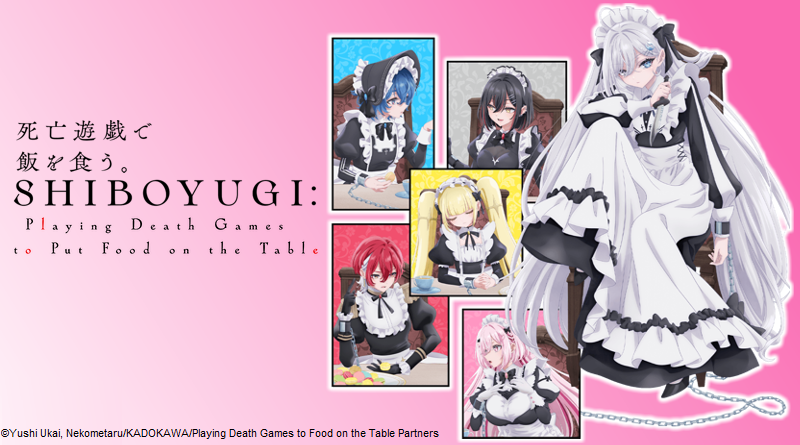
Based on the Japanese light novel series written by Yushi Ukai and illustrated by Nekometaru, the story follows Yuki, a 17-year-old professional participant in televised death games where survival means money and failure means death. Unlike most players who enter out of desperation, Yuki treats the games as a job, calmly calculating risks, helping others when it’s convenient, and ruthlessly prioritizing her own survival as she aims to achieve an unprecedented record of surviving 99 games. Her latest challenge drops her into the eerie “Ghost House,” where she awakens in a maid uniform alongside other girls trapped in a lethal maze of traps, locked rooms, and weapons. While the situation is horrifying for everyone else, Yuki’s experience allows her to approach the carnage with unsettling composure, yet beneath her professionalism lies a quiet uncertainty about why she’s so driven to keep surviving in a world where every room could become her grave.
On the technical side, this artsy anime adaptation was produced by Studio Deen and directed by Souta Ueno, with Rintarou Ikeda handling series composition, Eri Osada designing the characters, and Junichi Matsumoto composing the music. The opening theme song is “Ersterbend”, performed by Lin from Madkid, and the ending theme song is “Prayer”, performed by Chiai Fujikawa.
In a nutshell, the series follows Yuki, a teenage girl who repeatedly enters high-stakes death games for financial reward in a dystopian society where such brutality is normalized as entertainment. Structured around four distinct games, the narrative is at its strongest early on. The extended first episode serves as a gripping introduction, effectively establishing the world, Yuki’s detached yet quietly empathetic mindset, and the unsettling logic behind her participation. In later storylines, she consistently manages to sustain that momentum, reinforcing both the psychological tension and the show’s unique, almost meditative approach to survival horror.
Beyond its premise, the anime distinguishes itself through an intentionally unconventional storytelling style. It leans heavily into non-linear narration, fragmented timelines, and environmental storytelling, requiring viewers to piece together meaning rather than having it explicitly explained. Within these televised death games, contestants are genetically modified. Hence, their bodies produce white cotton fluff in place of blood and organs, a concept that sounds absurd on paper but proves surprisingly effective in execution. Rather than softening the violence, this substitution creates an uncanny, deeply unsettling atmosphere, where the absence of real gore somehow makes each injury feel even more disturbing. That cotton-stuffed imagery adds a layer of dehumanizing unease that lingers, amplifying the show’s quiet horror tone in a way traditional depictions likely wouldn’t.
However, the latter half struggles to maintain the same level of cohesion. The third and fourth games introduce intriguing setups but rush through their development, often skipping key moments that would otherwise deepen tension and emotional investment. As the series progresses, the narrative becomes increasingly difficult to follow; what begins as a fairly cohesive structure gradually gives way to something that feels scattered and almost random. While the fragmented storytelling is clearly intentional, it often undermines clarity, making it harder to track motivations or remain fully engaged, as if it wants to be Pulp Fiction with how it presents itself. Still, as a result, it keeps me from giving this a higher rating since a few of these “games” are technically prequel stories that kinda spoil who lives depending on how you look at it…
Visually, the anime is striking and undeniably distinctive. Its art direction embraces contrast, with close-up shots featuring intricate detail, particularly in the eyes, while distant scenes strip characters down to minimal forms against richly colored, almost painterly backgrounds. The use of outline-free imagery and muted palettes enhances the dreamlike, unsettling atmosphere. Animation is more restrained, often avoiding elaborate action sequences in favor of suggestion and implication, which both reflects budget limitations and reinforces the show’s subdued tone. The soundtrack complements this approach well, with ambient, melancholic compositions that heighten introspection, while the opening and ending themes leave a strong impression through their haunting, atmospheric presence.
Overall, this is a stylistically bold yet uneven anime that prioritizes atmosphere, symbolism, and artistic expression over narrative clarity, resulting in a deeply divisive but undeniably unique experience. At its best, it delivers a haunting “quiet horror” tone and a fresh take on the death game genre, driven by Yuki’s enigmatic presence and an unsettling audiovisual identity that lingers more through mood than plot. However, its increasingly fragmented structure, rushed developments, and lack of clear progression cause it to lose momentum, often making the story feel disjointed or difficult to follow. While viewers who appreciate experimental storytelling and interpretive depth may find it compelling and memorable, those seeking a cohesive, well-structured narrative will likely come away frustrated despite its creative ambition.