


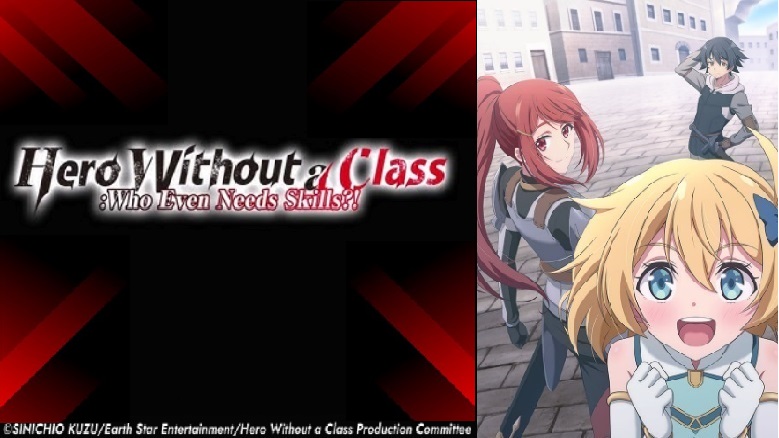
English Dub Review: Hero Without A Class: Who Even Needs Skills?! Season One
Based on the Japanese light novel series written by Shichio Kuzu and illustrated by Yumehito Ueda, this story unfolds in a medieval fantasy world where every child receives a “Class” at the age of ten, and the presence or absence of “Skills” determines one’s destiny. Arel, the son of the legendary “Sword Princess” Fara and the powerful “Magic King” Leon, is branded as “Classless,” an apparent flaw that makes him the subject of ridicule and doubt. Yet, despite lacking divine protection, Arel refuses to give up, believing that effort and determination can surpass what others are simply given. His journey begins as he faces mockery from peers blessed with classes and crosses paths with a fiery red-haired child tied to his mother’s adventuring circle, an encounter that sparks both rivalry and growth. In a world where power is predetermined, Arel’s resolve to forge his own path proves that even the “Classless” can become something extraordinary through sheer will and hard work.
On the technical side, this adaptation was produced by Studio A-Cat and directed by Kaoru Yabana, with series composition by Chabō Higurashi and Kento Asahina composing the music. The opening theme song is “Reincarnation”, performed by Kaya, while the ending theme song is “I Don’t Need Something Like a Miracle”, performed by members of the music group Utahime Dream.
At its core, Hero Without a Class explores the tension between destiny and personal effort, set in a world where divine “classes” define strength and social value. The protagonist, Arel, is deemed “classless” and expected to fail, yet he steadily progresses through observation, training, and perseverance. The premise allows for philosophical undertones about ambition and self-determination, but the story quickly gravitates toward familiar power-fantasy territory. Rapid introductions of new locations, challenges, and factions keep the pace brisk, yet the series often sacrifices emotional depth and nuanced world-building in favor of speed.
Arel embodies both the show’s appeal and its shortcomings. Calm, competent, and unflustered by the expectations placed upon him, he avoids many overused shounen clichés. However, his reliance on effort over innate blessing soon reads more like a hidden superpower than a genuine struggle. Victories feel inevitable rather than earned, and while supporting characters like Reiner, Farah, and a few Magic School students provide occasional charm and contrast, most supporting roles are fleeting and underdeveloped. The narrative prioritizes Arel’s skill accumulation over the growth or significance of others, reinforcing a low-stakes, almost whimsical tone.
As the season progresses, the story’s limitations become more apparent. Conflicts resolve too easily, stakes remain minimal, and frequent shifts in location leave little room for character attachment. Arel’s emotional detachment, while sometimes amusing, restricts depth, and the plot’s “effort beats talent” theme often collapses under scrutiny. The series flirts with parody and comedic commentary on overpowered protagonists, providing a few laughs and moments of levity, but never commits fully enough to transcend its genre conventions.
The animation and music are competent yet unremarkable. Action sequences are frequently implied rather than fully depicted, reflecting the show’s modest budget, and characters often remain static with minimal expressive variation. Voice acting adds some personality to otherwise subdued performances, while the soundtrack ranges from forgettable to oddly cheerful in tense moments, with standard idol-driven openings and endings that are serviceable, if potentially forgettable. Overall, the production supports the story without elevating it, maintaining functionality over flair.
Overall, Hero Without a Class is a mid-tier fantasy anime: not particularly memorable, yet oddly watchable. Its fast pacing, low-stakes conflicts, and overpowered protagonist deliver a satisfying “popcorn” experience, even if character growth and narrative stakes remain shallow. While it never reaches great heights, it provides a cozy, humor-tinged fantasy ride that fulfills its modest ambitions. If a Season 2 ever emerges, it would be worth a look, though the single season already stands as a self-contained, comfortably mediocre adventure.















"There are also other characters that come and go (also owned by the Warner Bros. Discovery conglomerate media company)."
Huh. Is that just referring to other characters from the show itself, or is this implying that the new season is going to have cameos from other WBD IPs