


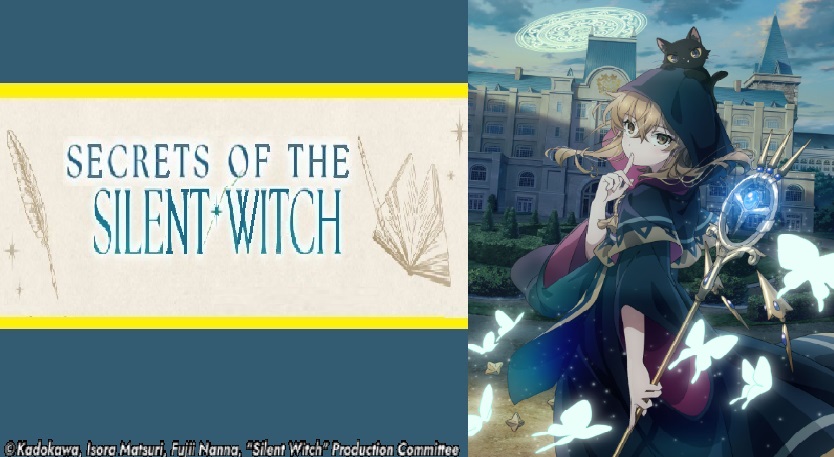
English Dub Season Review: Secrets of the Silent Witch Season One
Based on the Japanese light novel series written by Matsuri Isora and illustrated by Nanna Fujimi, the story follows Monica Everett, the titular “Silent Witch”, who is the world’s only practitioner of Voiceless Magic, a veritable heroine who single-handedly fended off the Black Dragon of legend. However, the young prodigy. Despite her incredible skill, Monica is a painfully shy, anxiety-addled mess of a person who would much rather live a quiet life far from attention, and only learned Voiceless Magic to avoid speaking in public. Ignorant of this, the Seven Sages have placed her on a top-secret mission to guard the Second Prince within the magic school where he currently resides. Can Monica keep it together as she contends with both social interaction and the possible threats that are targeting the young prince?
On the Technical side, this Anime was animated by Studio Gokumi, directed by Yasuo Iwamoto, with Takaomi Kanasaki serving as chief director and handling series composition and episode screenplays, Cona Nitanda designing the characters, and Cygames and Rina Tayama composing the music. The opening theme song is “Feel”, while the ending theme song is “mild days”, both performed by Hitsujibungaku.
At its core, Secrets of the Silent Witch follows Monica Everett, a young magical prodigy who is one of the Seven Sages, whose unparalleled mastery of magic is rivaled only by her crippling social anxiety and an unusual fascination with numbers reminiscent of Ben Affleck’s character in The Accountant. In a world where magic functions with the precision of advanced mathematics, structured, logical, and exacting Monica’s intellect makes her one of the most formidable mages alive, yet her overwhelming shyness has left her isolated both personally and professionally. Her life changes dramatically when she is tasked with a covert mission to protect the Second Prince at Serendia Academy, thrusting her into a complex environment of noble politics, inquisitive students, and hidden dangers. What begins as a simple undercover assignment evolves into a deeply personal journey of growth and self-discovery, as Monica learns to confront not only external threats but also the internal fears that have long constrained her. Blending magical intrigue with emotional depth, the series tells a tender, introspective story about courage, vulnerability, and the quiet strength found in stepping out of solitude and embracing connection.
Rather than relying on grand battles or elaborate worldbuilding, The Silent Witch distinguishes itself through emotional authenticity and a focus on quiet, gradual growth. Monica’s progress unfolds through small, human-scale moments, hesitant conversations, awkward social exchanges, and the courage to be seen, each step feeling earned and meaningful. Her relationships with classmates such as the kindhearted Lana, composed Claudia, and perceptive Felix serve as mirrors to her struggles, gently guiding her toward greater confidence and self-acceptance. While romance remains only a subtle undercurrent, the warmth, empathy, and understanding that develop between the characters lend the story emotional depth rarely seen in fantasy anime. Through this delicate storytelling, The Silent Witch transforms the mundane into the meaningful, proving that emotional bravery can be as powerful as any spell.
The writing masterfully balances introspection with narrative momentum, keeping Monica’s personal growth at the story’s core. Her development unfolds gradually, measured through small, consistent victories rather than sudden revelations, with humor soft, emotional beats tender, and conflicts rooted in internal struggle rather than spectacle. Supporting characters like Felix and Cyril gain depth as the narrative occasionally broadens beyond Monica’s perspective, highlighting the quiet struggles that accompany personal growth. The series emphasizes that courage often manifests in subtle acts of learning to trust, connect, or speak up despite fear and treats Monica’s anxiety with empathy, making her journey deeply relatable. Episodes 10 and 11 serve as particular highlights, offering a tragic glimpse into Monica’s past and a harrowing challenge she must confront, amplifying the emotional resonance of her journey. Even when the story drifts into slower, slice-of-life rhythms, these moments provide essential space for reflection, reinforcing the idea that true bravery lies in persistence and the incremental steps of emotional resilience rather than in dramatic triumphs.
From a production standpoint, The Silent Witch radiates quiet elegance and delicate warmth, perfectly matching its introspective tone. The animation employs a gentle pastel palette, soft lighting, and painterly backgrounds, capturing both the serenity of the academy’s courtyards and the intimate subtleties of Monica’s evolving world. Every expression, hesitant smiles, nervous glances, and slight shifts in posture are rendered with meticulous care, reflecting her inner turmoil and growth. Action sequences, though sparse, are choreographed with precision and emotional clarity, making each encounter impactful without relying on spectacle. Complementing the visuals, the musical score blends restrained piano motifs with subtle orchestral harmonies, enhancing moments of reflection, triumph, and vulnerability without ever overwhelming them. Together, the animation and music create a cohesive, immersive audiovisual experience that embodies the gentle, heartfelt nature of Monica’s quiet journey.
Overall, Secrets of the Silent Witch stands as a rare and quietly captivating fantasy that prioritizes emotional truth over spectacle, weaving a tender narrative of self-discovery, friendship, and the quiet resilience of a woman learning to find her voice. Its pacing leans toward the contemplative, and its scope may appear modest, yet that restraint is precisely what gives it power, allowing Monica Everett’s journey to unfold as a series of subtle, profound changes that mirror real human growth. The series’ strength lies not in flashy battles or intricate political intrigue, but in the emotional honesty of its protagonist and the gradual unfolding of her courage, showing that heroism can exist in vulnerability and that even the smallest steps toward self-acceptance can feel monumental. Thoughtfully written, gracefully animated, and accompanied by a soothing yet stirring score, this show reminds its audience that the most powerful magic often lies not in spells or combat, but in learning to speak one’s truth aloud. While there is currently no word of a second season, the story as it stands delivers a quietly memorable and heartfelt experience, a series that doesn’t need to shout to be heard; it simply whispers—and in doing so, leaves an unforgettable echo of warmth, resilience, and heartfelt wonder.























There's got to be some kind of twist that's going to happen with this. I don't know if they're setting up an April Fool's joke now or what's going on, but it seems too strange that they'd suddenly reverse on doing a fourth and fifth season after the show was already renewed and they were even just talking about working on those seasons like a couple months ago or something. Or maybe the two episodes yet to release will secretly somehow each be like a "season" in themselves?